What Is the Most Capital-Efficient Way to Acquire B2B Customers in 2027?
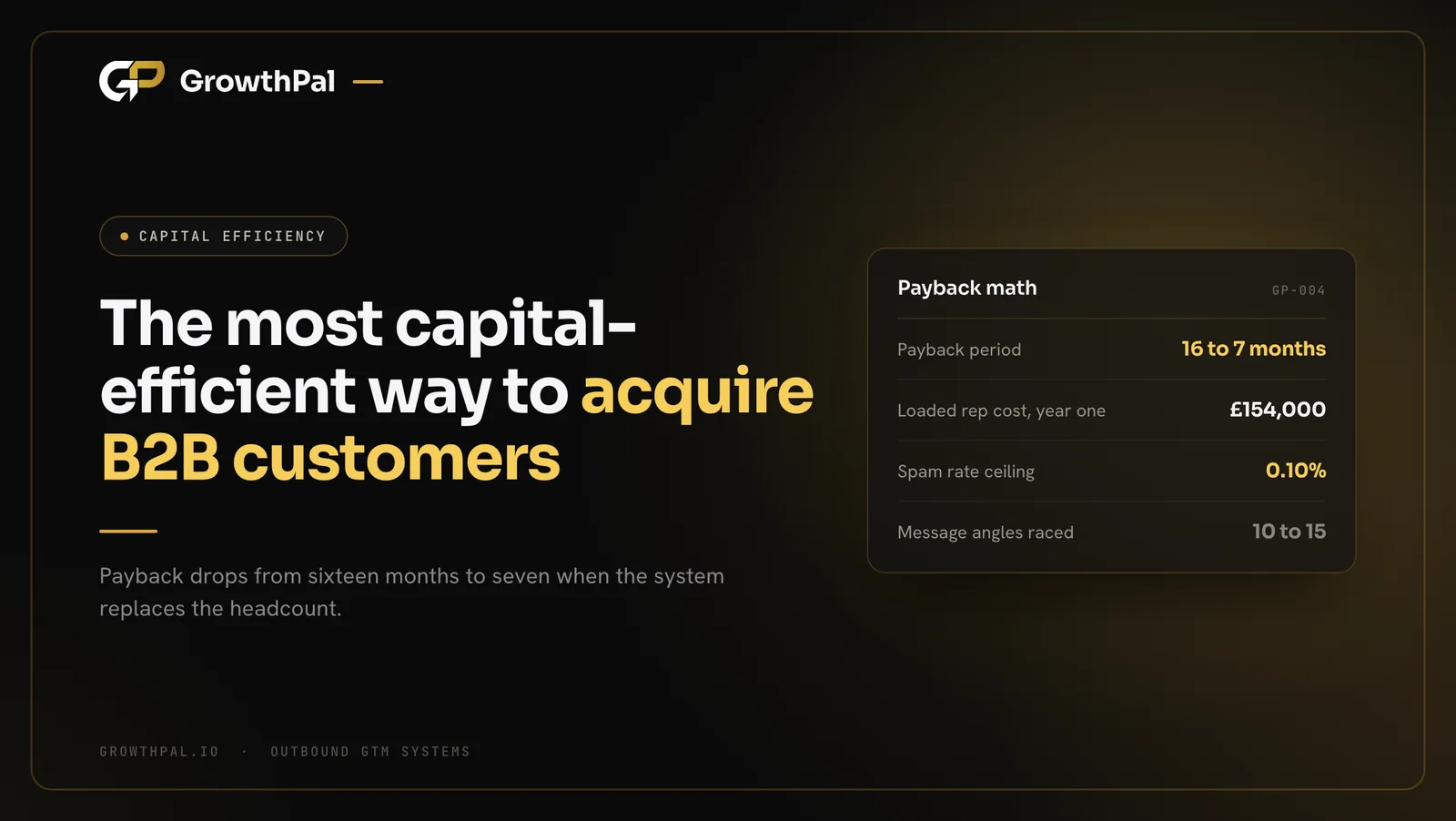
TL;DR For most B2B companies, the most capital-efficient way to add customers is a tested outbound system rather than early sales headcount. It sends within 2 to 4 weeks instead of a three-month rep ramp, and every dollar is judged on the qualified opportunities and meetings it produces. Size it to your market, test before you scale, and run the return arithmetic on your own numbers.
Many B2B founders hire large sales teams or buy expensive paid ads, pushing their payback periods beyond 16 months. This guide explains how to build a capital efficient customer acquisition engine that lowers costs. We compare a structured outbound system with hiring early sales staff.
Key takeaways
- Automated systems replace human data entry with API-driven waterfall enrichment.
- Google recommends keeping spam complaints below 0.10 percent and treats 0.30 percent as the ceiling.
- A fully loaded US sales rep can cost more than $150,000 in year one once tools, taxes and management are counted.
- Testing 10 to 15 different message angles helps find message-market fit fast.
- Secondary domains and extra inboxes protect your main brand from spam filters.
- Efficient pipeline creation relies on tracking intent signals like funding rounds.
How Does Capital Efficient Customer Acquisition Compare to an SDR Team?
Traditional sales teams bring high headcount costs and long training times. These factors heavily delay your financial payback when compared to a lean automated outbound system. This delay ruins early revenue growth.
Why did B2B outbound acquisition economics shift?
B2B sales rep tenure has dropped across the industry. The Bridge Group reported a median on-target earnings package of about $80,000 in 2025, before taxes, benefits and the software tools reps need daily.
The same research puts ramp time at about three months, which is three months of salary before a new rep produces steady pipeline.
How do you calculate the fully loaded cost of an SDR?
A manual sales rep requires an expensive tool stack. You pay for software on top of their base salary. Adding taxes, benefits, management time and data costs can push the fully loaded first-year bill past $150,000 for a US rep (Alleyoop, 2026).
Companies pay heavily for slow data entry instead of active selling time. An automated system shares one data and tooling stack across the whole market instead of buying it seat by seat.
Does manual prospecting limit capital efficient pipeline creation?
Human list building blocks capital efficient pipeline creation. One person can only research and email a small slice of your market daily. Enterprise buyers ignore generic emails sent in low volumes.
An API system maps your total addressable market in minutes. This speed lets you reach buyers before competitors build lists.
Why is GTM engineering vs sales headcount more efficient?
GrowthPal builds AI-native revenue infrastructure for B2B companies. This setup replaces manual searching with programmatic triggers and API-led outreach engines. GrowthPal has run this method for 40+ B2B companies across the US, UK, Europe and Australia, and judges every engagement on qualified opportunities and meetings against the fee.
A built system lets you test different angles across your entire market at once. You start scaling based on real data instead of guesswork.
How Do Google Bulk Sender Requirements Affect B2B Cold Email?
Strict rules from major inbox providers mean you must add technical safeguards before sending commercial emails. Missing these basic records causes instant rejections and ruins your domain reputation immediately. You must build a secure foundation first.
What are the new Google Postmaster Tools spam thresholds?
The latest postmaster thresholds enforce strict limits for bulk senders. As per 2026 Google guidelines, you must keep reported spam rates below 0.10 percent consistently to stay in the primary inbox.
Google treats 0.30 percent as the ceiling: above it, a domain loses eligibility for mitigation and filtering tightens fast. You must fix problems quickly.
How do you keep spam complaint rates under 0.1 percent?
Keep complaints low by sending highly relevant messages to the right people. Check your formatting with a free inbox preview tool before launching campaigns. Missing basic authentication records causes instant rejections.
Use a free spf checker to verify your setup quickly. Proper foundations ensure your emails land where buyers see them.
Why over-provision infrastructure for safety?
Safe outbound systems rely on secondary domains. GrowthPal over-provisions inboxes by 50 to 100 percent to act as redundancy. This ensures campaigns do not stop if one group of inboxes burns out.
We limit sending to 15 emails per inbox per day once ramped, at 2 inboxes per domain, which sits below published guidance from Clay and infrastructure providers. This disciplined volume protects sender reputation.
What Role Do RevOps and Data Foundations Play?
A clean data setup prevents high bounce rates and stops emails going straight to spam. It ensures your system launches targeted outreach only when the right market signals fire. Good data drives high conversions.
What is waterfall enrichment in cold prospecting?
Waterfall enrichment in cold prospecting sequentially queries multiple data providers until it finds a valid email address. This automated process replaces manual searching and drastically lowers bounce rates. Using multiple data APIs builds contact lists faster and much cheaper than a manual SDR could.
How do you audit your revenue operations data?
Revenue operations engagements start with an audit answering where data comes from and where it goes. You must identify who owns the data and whether it is correct. GrowthPal performs this check before building new systems.
Bad data foundations ruin deliverability and destroy conversion rates quickly. Fixing data flow is step one.
Does validating emails protect sending domains?
Verify your lists to keep bounce rates strictly under two percent. High bounce rates tell email providers you are guessing addresses blindly. We use tools like Reoon and BounceBan to ensure every contact is real.
A bounce rate calculator helps you track this metric. Clean lists protect domains from sudden suspensions.
How do trigger signals improve timing?
Capital efficient customer acquisition requires contacting buyers exactly when they need help. AI agents watch for triggers like recent job postings or new software installations. A managed service provider might trigger emails when unaligned DNS records appear.
This specific timing sharply increases positive replies. Reaching out right after a trigger event converts better.
How Can Algorithmic Testing Find Message-Market Fit?
Testing removes guesswork by racing multiple distinct angles against each other simultaneously. This method finds a winning message quickly without wasting your entire contact list. It scales the best ideas fast.
How does racing distinct message angles work?
Finding message-market fit involves racing 10 to 15 genuinely different message angles across your addressable market. Month one focuses on testing while ramping inboxes securely. Month two moves into aggressive testing against different market segments.
By week eight, you usually find a winning message. This data-driven approach removes emotion from your sales messaging.
How should you write for the B2B executive inbox?
Enterprise buyers avoid vendors who send irrelevant pitches, and poorly targeted cold outreach gets deleted on sight. Your emails must solve specific problems directly.
Checking copy with a cold email grader helps, but humans must approve every message. Executives reply to peers who understand their industry.
Can you achieve the one in 350 benchmark?
GrowthPal's aim is one qualified lead per 350 contacts reached, against an industry norm of 1 per 800 to 1,000. With fast follow-up, 25 to 40 percent of interested replies turn into meetings. For a D2C and retail client, GrowthPal's campaigns produced 183 positive replies from 43,043 emails over three months.
Before founding GrowthPal, Prabesh Khanal built and ran the Passionfruit campaigns with the same testing method; they produced 2,000+ qualified leads in nine months.
Capital Efficient Customer Acquisition: GTM Engineering vs Sales Headcount
Choosing between an automated system and manual hires decides your financial runway. Comparing these models shows stark differences in setup speed, software cost, and overall payback times. A capital efficient customer acquisition engine usually scales faster than headcount.
Comparing the financial models directly
| Metric / Dimension | Traditional 2-SDR Pod | Outbound system run by a GTM engineering team |
|---|---|---|
| Time to first sends | About three months of ramp per rep | 2 to 4 weeks from kickoff, including warm-up |
| What you pay for | Salaries, benefits, seats and management | Infrastructure, data, testing and the team's fee |
| How volume scales | Add headcount | Add inboxes and domains at 15 emails per inbox per day |
| What you keep | Knowledge leaves when reps leave | Domains, sequences, enrichment logic and routing rules, documented |
| How to judge it | Meetings per rep | Qualified opportunities and meetings per dollar |
Put your own numbers into both columns. GrowthPal's ROI calculator runs the outbound side: contacts reached ÷ 350 gives qualified leads, × 25 to 40 percent gives meetings, × your close rate and contract value gives revenue to set against the cost.
Why does CAC reduction in B2B outbound matter?
A 2026 ScaleXP study reported a 16-month median CAC payback for private B2B companies, and a 2025 KeyBanc Capital Markets survey put venture-backed firms at 20 to 23 months. Every month of ramp and every unproductive seat lengthens that payback; a system that produces pipeline within weeks shortens it.
How much depends on your close rate and contract value, so run the pipeline math on your own numbers before you decide.
Does infrastructure speed up time to launch?
A new sales rep needs around three months to reach full productivity on the floor. An automated outbound campaign takes only two to four weeks from kickoff to sending. System deployment happens very quickly.
You test your market faster and generate new pipeline much earlier. This speed gives agile startups a massive advantage over slow competitors.
How do you handle market size variations?
An automated engine works best when your market contains 30,000 or more reachable contacts. Results grow even larger if the addressable market exceeds 300,000 contacts. A human team would take decades to process this high volume manually.
Consulting firms with small markets still benefit from running hyper-personalised sequences. You simply adjust daily sending volume to match market size safely.
Scale Without Adding Headcount
GrowthPal builds and runs full-TAM outbound systems to find your message-market fit. We construct the infrastructure, manage deliverability, and handle reply routing so you can focus on closing deals.
How Does Data Privacy Affect Customer Acquisition?
Different countries enforce strict rules on how you contact corporate buyers via cold email. You must adapt your outreach to meet regional data laws. This protects your capital efficient customer acquisition engine from costly fines.
What are the UK PECR corporate subscriber rules?
The Information Commissioner's Office confirms you can send B2B marketing emails to corporate subscribers without prior consent. The uk pecr corporate subscriber rules apply to companies registered as Ltd, LLP, or PLC. You must provide a direct opt-out and ensure data complies with UK GDPR.
This is general guidance, not formal legal advice. Maintain a legitimate interests assessment.
How do you navigate European privacy directives?
The ePrivacy Directive remains very fragmented across Europe. Germany requires prior express consent for email advertising under section 7 of the UWG, even for B2B. Other countries sit at different points between consent and opt-out.
Always tailor your outbound strategy to the specific legal framework of each targeted country. This is general guidance; consult a lawyer for specific regional advice.
Enforcing technical opt-outs globally
RFC 8058 standardises the one-click unsubscribe header for modern emails. This allows mail providers to process unsubscribes automatically without forcing users to visit landing pages. Google and Yahoo require it on marketing mail from bulk senders.
It keeps your list clean and helps when comparing a cold email agency vs software approach to scale safely. Making unsubscribing easy prevents spam complaints.
When Should You Use Paid Ads for B2B Growth?
Paid advertising offers immediate visibility but struggles to match the precise targeting and low cost of outbound emails. You must balance both channels to grow efficiently. A capital efficient customer acquisition engine uses outbound to lower average costs.
Why are LinkedIn ads CAC so high for B2B startups?
LinkedIn holds excellent professional data, but the platform charges premium prices for impressions. Small software businesses often burn budgets quickly on broad campaigns. High cost per click makes it difficult to achieve capital efficient b2b growth.
Outbound email can reach the same buyers directly, at a far lower cost per conversation. You gain direct inbox access without paying a network for every view.
Platform restrictions on manual outreach
LinkedIn caps weekly connection requests, commonly cited at 100 to 200 a week, and limits personalised notes on free accounts. Aggressive filters now block unapproved browser scraping extensions heavily.
This forces companies to rely on external email systems instead of social platforms for scale. You cannot build a reliable sales engine on rented land.
Balancing inbound with outbound
Paid search captures high intent but remains highly competitive and expensive. Use paid channels when buyers actively search for software solutions.
Outbound works better for creating demand among prospects who have not yet realised their problem. A balanced approach uses outbound to test new messaging before spending large advertising budgets.
Maintaining a clean brand identity
If you run paid advertisements alongside outbound, you must protect your primary domain. Never send cold volume from your main website address. Use secondary domains with strict authentication instead.
Check every domain with a DMARC checker. Start at p=none, read the reports, then tighten your primary domain towards reject to stop spoofing.
How Do You Transition to a Modern GTM Engineering Approach?
Building a modern revenue engine requires changes to how you process data and target accounts. You must implement strong deliverability safeguards and automate tasks to achieve true scale. This shift requires technical expertise.
Identifying the right technology stack
You need a technology stack that supports API integrations and flexible routing. Software like Clay integrates with sending tools to automate list building and enrichment. AI agents can then draft angle variants quickly.
For Tracerrr, a GrowthPal client, this stack produced 78 positive replies from 53,508 emails over three months; the Tracerrr case study has the detail.
Developing team capability
GrowthPal founder Prabesh Khanal is a top 1 percent Clay user and coached Avik Ghimire to third place at Clay Cup 2026, Clay's global live GTM engineering competition. That depth is what these systems run on.
GrowthPal works in two ways: it builds the system and trains your team to run it, or runs it month to month with no annual lock-in. Our cold email agency page explains both.
Generating social impact through replies
We align outbound success with real social impact. For every human reply a campaign earns, GrowthPal funds food and health support for a street dog at Shree's Animal Rescue Nepal. This turns a routine sales process into a meaningful initiative.
Every human reply counts, including a polite no; auto-replies and bounces do not, and clients pay nothing extra. Your team stays motivated knowing their daily outreach creates a positive change.
Requirements for a capital efficient engine
- Register secondary domains separated from your primary brand.
- Configure SPF, DKIM, and DMARC records correctly.
- Implement RFC 8058 one-click unsubscribe headers.
- Warm inboxes for 14 to 21 days minimum.
- Connect an API-driven waterfall enrichment provider.
- Verify all emails to keep bounce rates low.
- Draft 10 to 15 distinct messaging angles.
- Limit sending to 15 emails per inbox daily.
- Monitor Google Postmaster Tools for spam spikes.
- Build an integration to route replies to sales.
Get Your Free GTM Blueprint
Claim a mapped market, buyer breakdown, five message angles, and five signal plays delivered within an hour. This blueprint reveals exactly how to structure your capital efficient customer acquisition engine.