How Do B2B Companies Choose Their First Outbound Segment Out of Several Possible Markets in 2027?
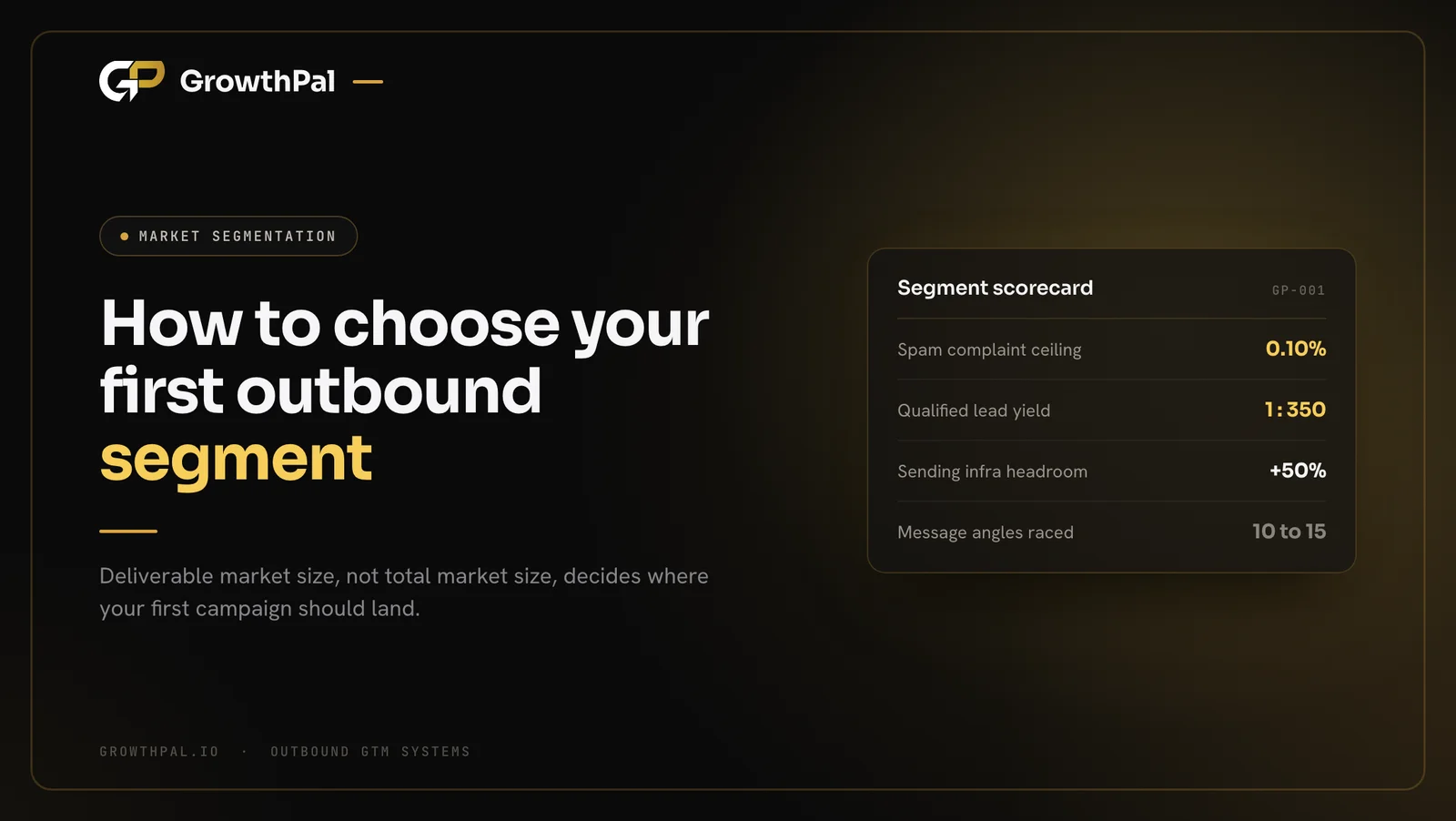
TL;DR Pick the first outbound segment that is big enough to test (30,000+ reachable contacts), feels an urgent problem, and has contact data you can reach cleanly. Then race 10 to 15 angles against it and judge it on one number: qualified leads per contacts reached, with 1 in 350 as the aim.
Picking a first target market means balancing big buyer problems with strict email math. This guide shows how to run B2B outbound market segmentation without burning your domains. You will learn to map lists against strict spam limits to find a safe, converting audience.
Key takeaways
- Calculate deliverable market size before launching any cold campaign.
- Keep spam complaints below 0.10 percent to protect sending domains.
- Prioritise segments with recent, verifiable intent triggers over static firmographics.
- Over-provision sending infrastructure by at least 50 percent for safety.
- Race multiple message angles to find a converting message quickly.
- Validate data ownership and flow before routing leads to sales.
How Do You Match Market Depth to Email Limits?
You must check if a market is big enough to test safely. A small list burns out fast under strict modern spam rules. Good outbound market segmentation prevents your domains from burning completely.
Why Do Email Volume Limits Dictate Segment Size?
Spam rules control every single cold campaign you run today. Google wants large senders to keep spam complaints strictly under 0.30 percent. Aiming below 0.10 percent is much safer for domain health.
A market must be large enough to absorb weeks of testing without running out. A list of 2,500 contacts is used up long before 10 to 15 angles each get enough volume for a clear read.
How Have Deliverability Rules Changed Recently?
Technical email limits grew strict between 2024 and 2026. Senders must set up correct verification records and give simple opt-out links. Sending one identical message across a huge market drives up complaints and can damage your sending domains quickly.
You cannot treat total market size as a bottomless list. Use a cold email deliverability checklist before you press send. Every single message must reach a real inbox safely.
Balancing Segment Value Against Inbox Burn
A high-value buyer group might look great but lack total contacts. Think of a software firm targeting 2,500 big enterprise accounts. A team sending 1,000 emails a month will completely burn this market in ten weeks.
Small markets need deep, personal outreach rather than high email volume. Always match your send tools to the real volume available.
How Do You Use Infrastructure Redundancy Safely?
Smart infrastructure setups stop your campaigns from breaking midway. GrowthPal will over-provision sending infrastructure by 50 to 100 percent for extra safety. This key step ensures campaigns do not halt if one set of inboxes burns out.
You can test new markets safely without hurting your main website domain. We always warm up new inboxes for 14 to 21 days before the first campaign email, and keep warm-up running afterwards.
How Do You Score Buyer Pain in Outbound Market Segmentation?
You must find buyers who face urgent money or time problems. A strong outbound market segmentation strategy targets real urgency over mild daily stress. This sharp focus speeds up the final sales cycle.
Where Do You Find Money and Time Problems?
Look for buyers dealing with hard deadlines or growing daily costs. Factory leaders care deeply about slow work and broken machines. Finance buyers stress over strict rules and secure data checks.
You must target the specific pain that forces them to act right now. Mild interest does not create a strong sales pipeline for your business.
Identifying Verifiable Intent Signals
Basic details like overall staff size mean very little on their own. You should look for verifiable intent triggers like new executive hires or fresh software setups. Web traffic spikes fade fast and lack real proof.
Real company actions show true urgency in the market. If a firm hires a new operations leader, they need help right away to fix bad systems.
Avoiding Broad Horizontal Market Slicing
Many technology firms slice their target audience too broadly. They try to sell basic tools to every business sector at once. Instead, you should segment by technographic install base to stay completely relevant.
Selling a migration service directly to current software users gives you a sharp angle. Broad and vague messages get almost zero replies in crowded inboxes.
How Do You Calculate Your Deliverable Outbound TAM?
Deliverable market size shows how many verified contacts you can safely reach within strict spam rules. This hard math keeps your cold campaigns totally realistic. It stops teams from building overly large prospect lists.
What is Deliverable Outbound TAM?
Deliverable Outbound TAM is the number of verified prospects you can safely reach via cold email without breaking spam rules. It respects mailbox volume limits and domain burn rates. This calculation keeps your sender reputation safe while predicting realistic lead flow.
How Do You Apply the Bounce Rate Rule?
Clean contact lists stop hard bounces and keep your sending accounts open. Your outbound file must keep bounce rates well under 2 percent. Raw scraped data often fails this critical test and hurts your brand.
GrowthPal uses verified waterfall enrichment to keep delivery rates consistently high. A simple bounce rate calculator helps you spot major risk before hitting send.
Factoring In Local Jurisdictional Laws
Cold email rules shift drastically across different international borders. The US CAN-SPAM Act pushed maximum fines to $53,088 per bad commercial email in 2025. Canada's CASL requires express or implied consent before you send commercial email.
The UK lets you contact corporate staff but requires a careful Legitimate Interests Assessment. Always check local privacy laws before you email a new region.
Sizing Segments for Safe Message Testing
You need enough unique contacts to test your messages properly. GrowthPal looks for at least 30,000 reachable contacts. 50,000+ is better, and 300,000+ is where results are largest. At the 1 in 350 aim, one pass across 30,000 contacts produces roughly 86 qualified leads, 50,000 roughly 143 and 300,000 roughly 857.
Smaller markets under 30,000 still work, but the testing phase takes longer to produce a clear read. You need a big enough pool to test different angles reliably.
Audit Internal Operations Before Launching Your Segment
You must make sure your internal team can handle incoming replies before starting. Fast daily responses turn interested emails into firmly booked meetings. Bad data flows completely ruin otherwise good cold email campaigns.
Securing Relevant Case Study Proof
Buyers want to see that you have solved their exact issue before. Having past success stories in a specific niche helps build instant trust. If you pitch to retail stores, show a retail win.
One d2c retail client drove 183 positive replies from 43,043 emails. You need similar strong numbers to win real trust fast.
Why Must You Audit Where Data Originates?
Every new campaign needs a perfectly clean data setup. A good project must audit where data originates, where it goes, and who owns it. You need to know the data is totally correct before moving leads.
Messy CRM systems cause chaos when good replies start rolling in. Fix your internal data rules before you launch the outreach.
Assuring Sales Team Bandwidth for Replies
Testing three new markets at once spreads your internal sales team too thin. Your staff must reply incredibly fast when good answers land in the inbox.
Industry studies put positive reply rates at roughly 0.5 to 2.0 percent (Orbitra, 2025). GrowthPal's own cold email benchmarks count differently, as interested replies per contact reached. Your sales team must have the time to convert these interested replies into firm calls.
Compare Markets Using a RevOps Scoring Matrix
Scoring tools remove emotion from the choice when you pick a market. Use a simple matrix to rank urgency, data access, and proof points. This clear method ensures your outbound market segmentation points to the safest option.
The Segment Prioritisation Framework
| Factor to Score | Segment A (High Volume) | Segment B (High Value) |
|---|---|---|
| Buyer Urgency | High pressure from rules | Low daily pain |
| Proof Points | Three related case studies | Zero existing clients |
| Data Access | Easy to find emails | Very hard to scrape |
| Inbox Load | Safe to test daily | Burns out in weeks |
Use this grid to rank your choices fairly. Pick Segment A for safe volume testing, and pick Segment B if you plan slow, careful account work.
Weighting Pain Against Infrastructure Limits
Balancing buyer pain against your strict sending limits is vital for success. A market might score high on big problems but fail completely on data access.
If you cannot find correct emails for the main buyers, that market fails. You should target spaces where you can extract clean contact details easily and safely.
Using an Email Volume Calculator
Knowing your exact volume needs stops you from ruining sender domains. You must match your available inboxes to the total market list. GrowthPal sets limits at strictly 15 emails per inbox per day once ramped.
This strict rule protects your reputation and keeps lead flow steady. You can use an inbox calculator to check limits before testing.
How Do You Compare Fintech to Healthcare?
Think of a software brand weighing a healthcare market against fintech. The health market offers 40,000 sites with a lower average price tag. The fintech side offers 2,500 firms with a huge price tag.
The large health market takes volume testing safely. The tiny fintech market burns out too fast for a safe cold email test.
Outbound Services
Full-TAM outbound systems built and run to find message-market fit. We calculate deliverable market size and test angles safely.
View Our Fully Managed Outbound Infrastructure. →
Map Out Intent Signals for the Chosen Market
Buying signals show exactly when a business needs your help today. Watching these specific triggers stops you from emailing people who are not ready. This keeps your overall list highly engaged and safe.
Tracking First-Party Job Changes
First-party hiring triggers are powerful indicators of true internal change. When a firm hires a new boss, that boss brings a fresh budget. Reaching out to new leaders in their first month works very well.
These new buyers want to make quick, easy wins. You can watch job boards to find these exact leadership moves.
Monitoring New Technology Installations
Adding new software shows big internal shifts at a company. If a brand installs a new marketing hub, they will likely need help connecting it. You can track data to find these fresh tech setups.
Your email wins attention when it names a recent tech choice. Generic notes fail while specific software comments grab real interest.
Why Does Competitor Dissatisfaction Work?
Frustrated buyers are actively seeking alternatives to their current daily tools. You can look for firms leaving bad reviews about your direct rivals. Service agencies win a lot of business using this exact trigger.
Writing to an angry client brings a much higher reply rate than standard cold notes. Simply show how you fix their exact posted complaint.
Launch Message Testing to Validate Your Outbound Market Segmentation
Once you pick a market, you must test distinct messages to see what clicks. Finding the winning angle proves your outbound market segmentation strategy works. This deep testing phase builds truly predictable revenue.
Racing Angles Across the Market
You should never bet your whole campaign on just one email style. We race 10 to 15 genuinely different message angles across the whole addressable market. We use buyer signals to decide who gets emailed first.
This hard testing uncovers what buyers really want to fix. A clear winning message usually appears by week eight.
Aiming for the Standard Benchmark Target
Your main goal is to build predictable lead generation week after week. The growth benchmark aim is one qualified lead per 350 contacts reached.
For comparison, the industry baseline for an untested message is 1 interested reply per 800 to 1,000 contacts. Getting from there to 1 in 350 is what the first two months of heavy testing are for.
Keeping Messages Short and Direct
You should remove all marketing fluff from your opening cold notes. A great opening lines up a clear trigger like a recent hire. Just state the problem flatly and ask if they want to see a guide.
Reading how we write a cold email angle shows you how to stay direct. Busy executives reply best to very brief emails.
Monitoring the Phased Testing Process
Good testing needs careful daily tracking to avoid strict spam traps. Month one involves testing while slowly raising the daily send counts. Month two focuses on pushing the best angles much harder.
Month three scales the clear winner across the whole group. This careful path secures message market fit safely and protects sender domains.
Finalise Your B2B Outbound Segment Choice
Finalising your choice means dedicating real tools and time to the plan. You must align data lists, domains, and templates with your new target audience. A tight launch stops costly early operational mistakes.
Setting Realistic Meeting Expectations
You must grasp the exact conversion math before you press send. Roughly 25 to 40 percent of interested replies become meetings with fast sales follow-up.
An interested reply cools within an afternoon, so plan for same-day responses before you launch. Speed and strict focus win more meetings.
Scaling Safely with Automation Tools
Modern software does the heavy lifting for your daily sending tasks. AI agents can scrub lists, watch for signals, and route replies fast. They monitor deliverability and draft angle variants to save major time.
When checking a cold email agency vs software, remember a real human must still approve every note. Code helps speed, but human checks ensure quality.
Reviewing Results and Adjusting Course
You must track the right numbers to measure real campaign success. If a list fails, you must find out if the words or the bounce rates caused the drop.
One GrowthPal reactivation campaign for a real estate client produced 104 opportunities in 27 days from 1,116 contacts. Good weekly reporting shows you these fast wins so you can adjust.
The Market Selection Checklist
- Ensure your market holds at least 30,000 reachable contacts.
- Keep total bounce rates strictly below 2 percent.
- Check that daily spam complaints sit under 0.10 percent.
- Audit internal data flows for new incoming leads.
- Ready three relevant case studies for the specific niche.
- Find a clear time or money trigger forcing action.
- Over-provision your sending inboxes by 50 to 100 percent for safety.
- Cap sending at 15 emails per inbox per day once ramped.
- Write 10 to 15 different message angles to test.
- Make sure a human approves all outgoing cold messages.
Free GTM Plan
A mapped market, buyer breakdown, 5 message angles, and 5 signal plays delivered within an hour. Launch your outbound market segmentation with data.