Which Numbers Prove a B2B Pipeline Is Predictable in 2027?
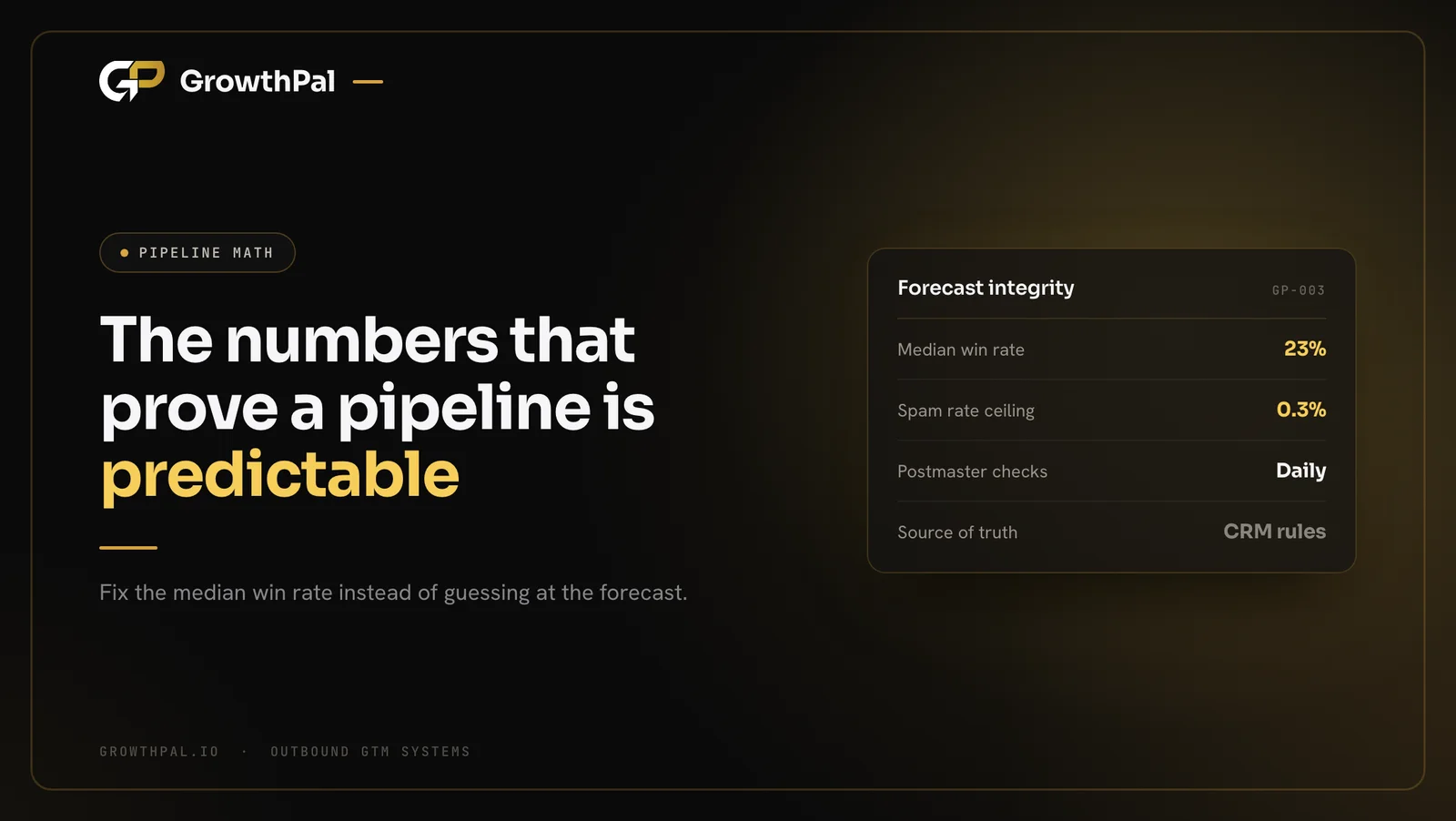
TL;DR A pipeline is predictable when coverage is set from your real win rate, every stage has hard exit criteria, stale deals are purged, and the top of the funnel runs on a tested conversion rate. At a 23 percent win rate you need roughly 4.3 times coverage, not the 3 times most plans assume.
Founders often look at a full CRM dashboard while their quarterly revenue misses the mark. To fix this, you must learn how to measure pipeline predictability using strict data. This guide explains which predictable pipeline metrics prove your revenue relies on facts rather than luck.
Key takeaways
- Base your pipeline coverage on your real closed-won conversion rates.
- Check Google Postmaster Tools daily to keep spam rates below 0.3 percent.
- Force strict stage exit criteria to stop sellers from hiding bad deals.
- Flag any opportunity pushed more than three times to cap deal slippage.
- Clean your CRM monthly to remove dead deals that ruin cash flow plans.
- Build over-provisioned sending systems to keep your meeting volume stable safely.
Why Do Traditional Models Fail Predictable Pipeline Metrics?
Most operations teams use static rules that ignore past conversion data. True predictable pipeline metrics require dynamic math models to replace old guesswork.
How do you derive coverage from your win rates?
A basic coverage rule assumes a flat win rate across all segments. The Bridge Group reported a median closed-won win rate of 23 percent across B2B software vendors in 2026. At that win rate, required coverage is about 4.3 times your remaining target (1 ÷ 0.23).
Using basic pipeline math stops major forecast misses. It forces you to base your goals on reality.
How should you adjust for past conversion data?
Revenue accuracy requires strict tracking between clear stages. Operatix found in a 2026 benchmark that 52.7 percent of held meetings become accepted opportunities. If your conversion rate drops lower, your SDRs are passing bad accounts.
You must track your lead to opportunity conversion rate closely to spot early friction. Finding this friction early saves your quarter from a total collapse.
Why does seller optimism ruin your forecasts?
Deals pushed multiple times destroy your forecast accuracy. Blue Ocean Sales Analytics estimated in 2026 that opportunities pushed more than three times create a 2.8 times sales pipeline velocity drag. These delayed deals close at a sub-seven percent rate compared to fresh pipeline.
Operations teams must make sellers mark stagnant deals as lost. Holding onto hope ruins your data models.
What is the benchmark for SDR meeting output?
Clear inputs create clear outputs for your teams. Outbound SDR teams average 10 to 12 held discovery calls per month, according to a 2026 Tam To Target benchmark. To model this output, you must test your reply rates first.
Using a reply rate calculator helps leaders set realistic weekly goals for their teams. Realistic goals keep your sellers motivated and on track.
How Does Deliverability Drag Affect Predictable Pipeline Metrics?
Upstream technical failures slow your top of funnel velocity long before deals reach your CRM. Operations teams must watch sender health to keep predictable pipeline metrics stable.
How do you enforce the strict spam ceiling?
Google requires domains sending bulk email to keep spam complaint rates below 0.3 percent, and recommends staying below 0.1 percent. Above the ceiling, Gmail stops offering mitigation and filtering tightens quickly.
Teams should use a cold email deliverability checklist to keep their inbox placement high. Without strict rules, your pipeline generation will stop entirely. Deliverability remains the true foundation of your outreach.
How do you authenticate mail for corporate inboxes?
Microsoft forces bulk senders to authenticate mail sent to consumer and corporate inboxes. Unauthenticated traffic gets permanent SMTP rejection codes at the gate.
Your setup must include aligned Sender Policy Framework and DomainKeys Identified Mail records. One missing DNS record can block hundreds of valid outreach messages. Operations leaders must audit these records every single month to prevent issues.
How do you bound weekly invitation volume?
Predictable revenue indicators cross multiple channels, including social selling efforts. Salesforge estimated in 2026 that the safe weekly limit for connection requests sits between 80 and 100 invitations.
Passing these unofficial limits triggers fast account bans. Predictable systems rely on staying safely inside these scoring rules every single week. Consistent daily actions beat massive outreach spikes every time.
Which CRM Rules Verify That an Opportunity Is Real?
Sellers often pitch buyers who never agree to concrete next steps. You must enforce strict exit criteria to make sure deals show genuine buyer intent.
What are the stage exit criteria for an SQL?
A Sales Qualified Lead needs clear proof of buyer intent before it moves forward. The seller must get a calendar invite, define the core problem, and confirm the timeline. Without these exact data points, the opportunity stays a disqualified prospect.
How do you cap deal slippage and push counts?
Your CRM must limit how many times a seller can push a close date. Capping deal slippage and push counts is vital.
This basic rule forces true honesty across the sales floor. Constant deal slippage hides deep conversion problems.
Flagging Stage Stagnation Before Decay
Deals sitting untouched require fast operations action to protect accuracy. If a deal sits in its stage for double the average time, the system must trigger an alert.
You must force a change to a closed-lost status due to long inactivity. Keeping dead deals open creates a dangerous coverage trap. Clean pipelines always forecast better than bloated ones.
Documenting Corporate Compliance Data
Cold outreach must follow regional data rules strictly. Under the UK Privacy and Electronic Communications Regulations, cold marketing to corporate subscribers is fine with a clear opt-out.
Sole traders require clear prior consent. GrowthPal always logs valid source data before campaigns start to maintain legal boundaries. Staying compliant protects your brand from severe fines and domain bans. This is general guidance, not legal advice.
How Do Operations Teams Audit Top of Funnel Conversion?
A predictable pipeline starts with a tested message hitting a verified market. Revenue operations teams must test reply quality heavily before they scale their sending volume.
Racing Angles to Find Conversions
Message-market fit needs heavy testing across your market. On one GrowthPal campaign board, seven angles raced against the same market produced positive-reply shares from 52 to 83.47 percent; the winner earned 202 positive replies from 4,303 contacts. The spread is the message. Month one tests angles while ramping inboxes safely.
A spam word checker keeps your outreach text clean. A winning message usually surfaces by week eight, giving you a predictable meeting flow.
Setting the Conversion Benchmark
Predictable revenue needs clear input and output numbers to work. GrowthPal aims for a benchmark of one qualified lead per 350 contacts reached.
Once you know this ratio, you can forecast your required contact lists accurately. If conversions drop, operations teams must pause sending and fix the core offer. Scaling a broken offer just burns your total addressable market faster.
Replacing Volume With Targeted Signals
Raising send volumes blindly kills your domain trust fast. AI agents can watch for market signals to decide who gets an email first.
Signals set the order, not the boundary. The whole market still gets covered, because in GrowthPal's campaigns a large share of interested replies come from companies with no public signal at all. If you are deciding who should run this, our cold email agency vs in-house SDR comparison sets out the trade-offs.
What Happens When Deal Decay Distorts Cash Flow Forecasts?
Unqualified deals in the pipeline create a false sense of security for your plans. Revenue leaders must separate real pipeline velocity from dead deals to protect their cash flow numbers.
Comparing Stagnant Versus Active Pipeline Stages
| Deal Status | Close Date Pushes | Stage Duration | Predictability Value |
|---|---|---|---|
| Active Deal | Zero to One | Under 30 Days | High Probability |
| At Risk | Two Pushes | 30 to 60 Days | Low Probability |
| Stagnant | Three or More | Over 60 Days | Zero Value |
| Decayed | Four or More | Over 90 Days | Negative Drag |
Choose active deals if you need to report reliable forecast figures. Choose stagnant deals if you just want to inflate your vanity metrics artificially.
Understanding Acquisition Cost Paybacks
Predictable pipeline metrics must account for delayed returns on your spending. The SaaS CFO estimated in 2026 that the median customer acquisition cost payback period reached 16 months.
Stagnant deals delay this payback even more. Operations teams must flag deals that stretch past average sales cycles to protect capital. Protecting capital ensures your company survives long enough to scale up.
Modeling Enterprise Buying Cycles
Enterprise software deals involve multi-stakeholder buying groups containing six to ten contacts. Single-threaded deals have zero percent predictability in these large accounts.
Your CRM must demand multiple contacts before a deal moves to the proposal stage. Sellers who fail to multithread will miss their quarterly revenue targets constantly. Operations must enforce this rule to secure large contract closures.
Tracking Rep-Level Forecast Accuracy
Operations leaders must track how well sellers predict their own wins. If a seller constantly forecasts deals that push to the next quarter, their pipeline value requires a heavy discount.
Standardising these tracking rules ensures your overall company forecast remains highly accurate. You must reward accurate forecasting just as much as you reward closed revenue to build good habits.
Stop Relying on Luck
GrowthPal provides complete Outbound Services to build capital-efficient pipeline infrastructure. We find message-market fit by racing different angles across your total addressable market, securing predictable meetings. Discover how our managed systems protect your deliverability and revenue forecasts.
Where Should Revenue Operations Begin Their Pipeline Audit?
An operational audit must answer where data starts, who owns it, and if it stays accurate. Unverified data foundations will always produce broken pipeline forecasts.
How do you map the technical foundation?
Every job must begin by mapping the current technical setup completely. GrowthPal starts every revenue operations project by auditing where data comes from, where it goes, who owns it, and whether it is right.
You cannot build good reports until you clean this data foundation entirely. Fixing the root data issues prevents complex workflow errors later on.
Standardising Definitions Across Teams
Sales and marketing teams often use clashing definitions for leads. You must clearly split a stage two discovery deal from a late proposal.
Shared definitions ensure everyone speaks the exact same commercial language. Without them, evaluating cold email agency alternatives or complex software becomes totally impossible. Your teams must agree on what a qualified opportunity actually looks like today.
Purging Open Pipeline Monthly
Good CRM hygiene requires aggressive monthly data purges to stay accurate. Operations teams must force sellers to mark inactive deals as lost.
You should check the reasons for lost deals to spot product flaws or pricing issues. A small, real pipeline beats a massive, decayed list of uncontactable prospects. Clean data gives leaders the confidence to make bold financial decisions.
How Does Managed Architecture Improve Deal Predictability?
Scaling outbound campaigns requires strong infrastructure that absorbs technical limits easily. This ensures strict provider rules never stall your active pipeline generation process.
Why is over-provisioning for redundancy critical?
Deliverability drops can ruin a quarterly forecast fast. GrowthPal over-provisions inboxes by 50 to 100 percent to act as complete backup redundancy.
Over-provisioning for redundancy stops campaigns from failing if one set of inboxes burns out. Protecting your sender reputation ensures that meeting volume remains stable despite changing provider rules. Stability at the top of your funnel secures your downstream revenue.
How do you generate reply volume at scale?
High-volume setups produce strong returns when you manage them well. For a D2C and retail client, GrowthPal's campaigns produced 183 positive replies from 43,043 emails between April and June, across North America and Europe, inside the same strict sending limits.
The point for forecasting is the denominator: once you know replies per email or per contact for a tested angle, volume becomes a planning input instead of a hope. Managed infrastructure handles the technical load so your sales team can focus purely on closing deals.
Maintaining the Bounce Rule
Hard bounces destroy domain trust and inbox placement rapidly. GrowthPal checks all contact lists with Reoon and BounceBan to keep bounce rates under two percent.
Bad list hygiene triggers spam filters and blocks your messages. Verifying contacts before sending protects your entire revenue operations pipeline metrics. Clean lists ensure your well-crafted outreach actually reaches the primary inbox of your ideal buyer.
Pacing Deliverability Ramp Periods
New inboxes need careful warming before you contact any prospects. Inboxes must be warmed for 14 to 21 days, then ramped slowly at 5, 8, 11, and 15 emails per inbox per day.
Following these exact limits proves you respect mailbox rules. This keeps your communications safely out of the spam folder. Patient ramping creates long-term outbound success.
How Do Operators Maintain Pipeline Accuracy Over Time?
Multi-year accuracy requires constant checks of seller habits and technical sending setups. Leaders must lock their predictable pipeline metrics now to scale safely tomorrow.
Auditing Rep Disqualification Habits
Sales operations teams must watch how fast sellers disqualify bad prospects. A seller who clings to bad leads will inflate your coverage ratio artificially.
Building automated CRM flows to flag long stage durations forces sellers to face reality. Honest disqualification habits produce highly accurate b2b pipeline predictability metrics. Teams must celebrate fast disqualifications to keep the CRM lean and mean.
Accounting for Seasonal Cycles
Predictable metrics must discount known industry blackout periods completely. E-commerce technology pipelines tie heavily to merchant seasonal cycles.
Revenue models must heavily discount deals expected to close between November and December. Missing these known market realities will create massive revenue shortfalls at year end. Your operations team must adjust the forecast to reflect how your specific buyers actually behave.
Modeling True Pipeline Mathematics
Hard math matters more than dashboard graphics. If your past win rate is 22 percent, your required pipeline coverage is 4.5 times your remaining target.
An inbox calculator helps you find exactly how much sending volume you need to hit this target. Precise math always beats optimistic guesses. Build your revenue engine on verifiable facts rather than pure hope.
B2B Sales Pipeline Audit Checklist
- Calculate required coverage using past win rates.
- Keep Google Postmaster spam complaint rates below 0.3 percent.
- Confirm SPF, DKIM, and DMARC records match perfectly.
- Force strict exit criteria for every CRM deal stage.
- Build automated alerts for deals pushed more than three times.
- Change deals stagnant for 60 days to closed-lost status.
- Check all corporate contacts against PECR opt-out rules.
- Multithread enterprise deals with at least six committee contacts.
- Track seller-level forecast accuracy every single month.
- Check contact email validity using Reoon and BounceBan tools.
Map Your Total Addressable Market
Get a Free GTM Plan from GrowthPal to build a predictable revenue engine. You receive a mapped market, full buyer breakdown, five message angles, and five signal plays delivered within an hour. Claim yours to secure verifiable pipeline growth.