How Do You Separate a Weak Offer From a Weak List When Outbound Underperforms in 2027?
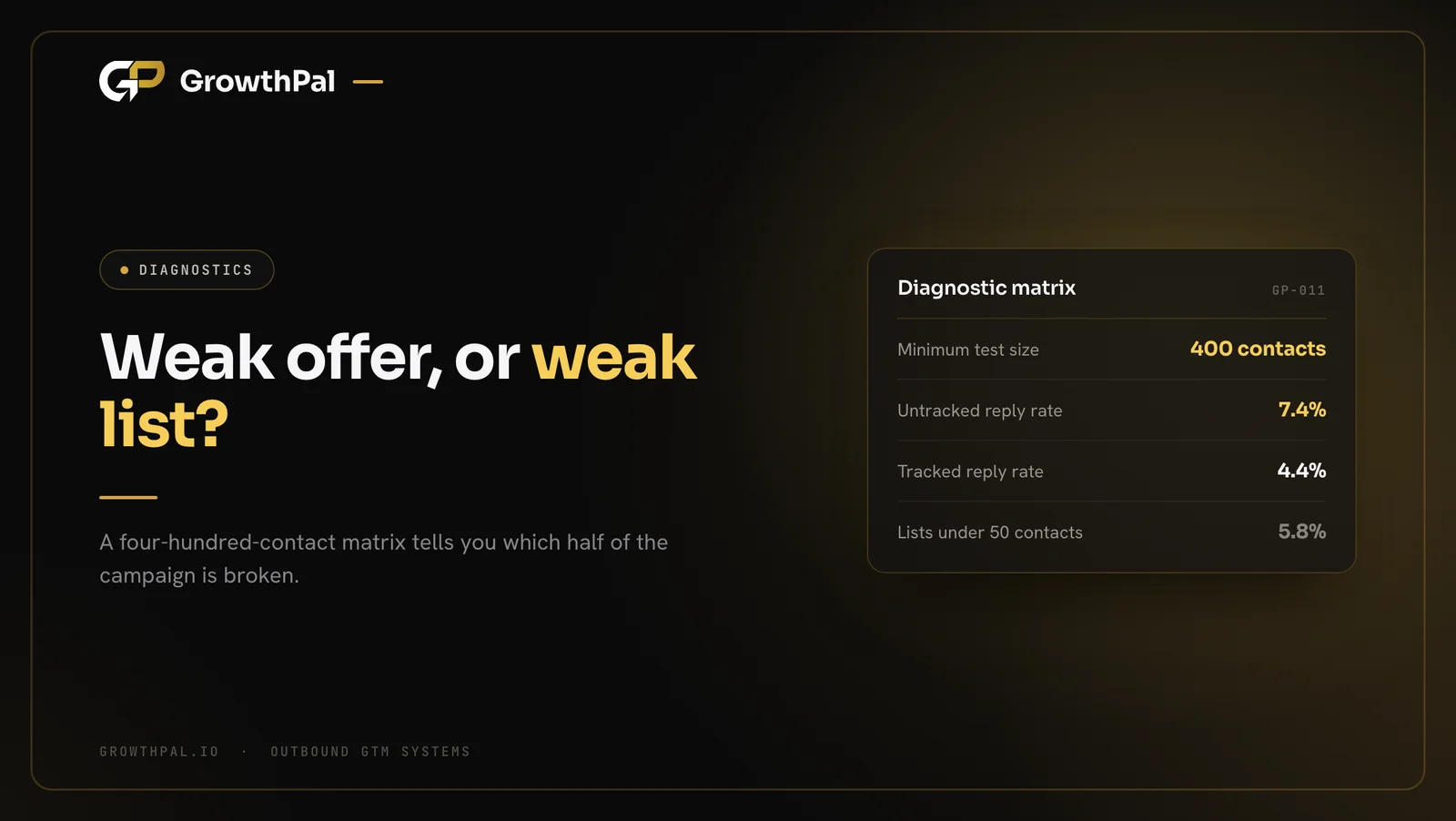
TL;DR To diagnose failing cold email campaigns, rule out deliverability first, then read what replies actually say, then test offers against segments in a simple matrix with at least 400 contacts per cell. Confused replies point to the list; clear, polite rejections point to the offer.
You might think your cold emails fail because your copy lacks punch. However, silent spam filters and bad data often kill campaigns before prospects even read them. This guide helps you diagnose failing cold email campaigns by separating bad lists from weak offers.
Key takeaways
- Google requires bulk senders to keep spam complaints strictly below 0.30 percent.
- Campaigns sent without tracking pixels see 7.4 percent reply rates compared to 4.4 percent for tracked emails.
- Test at least 400 contacts per variant before you read a result.
- When targets reply with total confusion about your product category, your list targeting is completely broken.
- Over-provisioning inboxes by 50 to 100 percent offers safety if one set of inboxes burns out.
- Forty two percent of all outbound replies happen on touches two through four.
What Is The First Step To Diagnose Failing Cold Email Campaigns?
Finding the root cause of an underperforming outbound campaign requires stripping away vanity metrics to see if prospects are hostile or bored.
Are people not replying because my offer is bad or because I am emailing the wrong job title?
You must test strictly to separate these two failure points within your outbound system.
Your list is broken if targets reply with total confusion about your product category. You must test well to isolate a weak offer vs weak list outbound.
What is considered a healthy positive reply rate today?
A 2025 Belkins study shows average business cold email reply rates sit at 0.45 percent against delivered emails. Good intent signals and exact firmographic targeting push this baseline higher.
GrowthPal aims for one qualified lead per 350 contacts reached through fast message testing. The industry baseline for an untested message is 1 per 800 to 1,000.
Why does cold email work for founders on LinkedIn but flop for SDRs on email?
Founders hold high corporate authority that junior sales staff simply lack. Belkins data from 2025 shows founders get a 0.57 percent reply rate, while enterprise vice presidents get 0.32 percent.
Furthermore, LinkedIn restricts daily sending volume sharply. This forces you to build narrow account lists rather than blasting generic messages.
Defining the baseline for a modern outbound diagnosing process
Finding campaign faults demands clear operational data across your entire revenue system. You must track domain limits and message variants to spot real failures quickly.
We advise checking a cold email deliverability checklist first. This confirms your technical health before you launch any new sequences.
How Do You Rule Out Deliverability and Infrastructure Issues?
Before testing your core offer, verify that your technical foundation can reach the primary inbox without waking up automated enterprise spam filters.
How do I know if my emails are going to spam without tracking pixels?
You must watch bounce codes and use external seed tests constantly to monitor inbox placement. Tracking pixels harm delivery because modern security tools block hidden images automatically.
Hunter shared a 2025 benchmark noting emails without pixels hit 7.4 percent reply rates. Tracked emails only reached 4.4 percent.
Which thresholds should you watch?
Google tells bulk senders to keep spam complaints strictly under 0.30 percent. A permanent target under 0.10 percent is much safer.
Keep bounce rates under 2 percent, which verification buys before the first send. Use a bounce rate calculator to track these limits tightly.
How can I separate technical domain damage from message burnout?
Technical damage causes sudden zero reply rates and sharp rejection codes. Message burnout shows a slow drop in positive replies.
We separate these issues by over-provisioning inboxes by 50 to 100 percent to act as secondary redundancy. This ensures campaigns do not stall if one set of inboxes burns out.
How Can You Read Semantic Reply Signals To Diagnose Failing Cold Email Campaigns?
Prospects tell you what is wrong with your campaign if you learn to decode their written rejections and sort their specific pushback.
If prospects reply 'not interested', is that a list issue or an offer issue?
A prospect saying they are not interested points to a weak offer. The targeting is correct because the email reached a relevant person who understood the pitch. A list issue creates confused replies stating you have contacted the wrong department entirely.
What ratio of neutral or objection replies indicates strong targeting?
Getting specific budget objections means your initial targeting is highly accurate. The person matches your profile but lacks the money to buy today.
Tracking these exact responses helps you find message market fit without binning good contact lists too early.
How do I tell if my email was screened out by Gemini or Microsoft Defender?
Enterprise AI filters silently send automated messages to quarantine without logging a formal bounce. Your software will incorrectly show the email as delivered.
Security scanners can also click every link in a message, including unsubscribe links, which shows up as a sudden wave of opt-outs nobody chose.
Why do follow ups get angry opt-outs while the first email is ignored?
Prospects ignore a single bad email but get frustrated by automated persistence.
SalesHive shared a 2026 benchmark showing 42 percent of outbound replies happen on touches two through four. You just need to space these touches well to avoid annoying your core market.
Execute The Factorial Diagnostic Matrix Test
You must test multiple offers against different market segments at once to generate clean data that isolates the specific variable causing failure.
How many emails do I need to send before a test is statistically significant?
Small samples give noisy data: with only a few hundred contacts, one or two replies swing the rate wildly.
Reply rates also tend to fall as lists get bigger and broader, so compare variants at similar list sizes. You need at least 400 contacts per test variant to gather clear signals.
How do I test an offer without burning our secondary sending domains?
Testing needs strict volume limits and domain separation. Keep each active inbox to exactly 15 emails per day.
We race 10 to 15 genuinely different message angles across the entire addressable market to find the one that yields 1 interested reply per 350 contacts.
Should I change my value proposition or narrow my ICP first?
Always change your proposition first if your bounce rates and domain health look fine. Narrowing your customer profile cuts your addressable market.
You can run the numbers through a reply rate calculator to model different proposition outcomes. If multiple angles fail across a broad market, consider narrowing your list criteria.
Evaluate The Diagnostic Output And Decide Next Moves
Once your matrix data comes back, you must compare the numbers to determine your path. This disciplined analysis stops you from making rash changes to your core strategy.
Comparing list failure against offer failure
| Diagnostic Signal | Offer Failure Root Cause | List Failure Root Cause |
|---|---|---|
| Polite rejection on budget | Ask is too large | N/A |
| Wrong department reply | N/A | Incorrect job title |
| Hostile unsubscribe | Value proposition irrelevant | Scraped generic contacts |
| Consistent silent ignores | Lack of clear urgency | Messages trapped in spam |
You must isolate these exact signals before rewriting your sequences. This simple matrix prevents costly strategy shifts.
Can a great offer salvage a scraped and unverified list?
A strong proposition cannot fix broken delivery infrastructure or bad contact data. Unverified emails cause immediate bounces that destroy your domain trust fast.
We use Reoon and BounceBan to keep bounce rates strictly under 2 percent. You must clean your data immediately before pressing send.
Is zero replies over 200 sends an automatic infrastructure red flag?
Sending 200 emails without a single reply usually means your domain is on a silent blacklist. Pause the campaign and check your core DNS records.
Test your technical setup using a dmarc checker before turning systems back on. A perfect pitch cannot escape a fundamental DNS failure.
Does low engagement mean our pricing model is fundamentally unviable?
Low cold email engagement rarely reflects your actual pricing model viability. Reachoutly estimated in 2025 and 2026 that the meeting to deal conversion average is 1 deal per 464 emails sent.
You must ask yourself why is cold email not working for this specific segment before blaming your product pricing.
Stop Guessing Why Your Outbound Is Failing
Our Outbound Services build and run full-TAM systems to help you find message-market fit safely. We isolate your weak offers from bad lists using rigorous testing protocols.
Industry Context When Troubleshooting Cold Email Campaigns
Sector rules dictate response thresholds, meaning a broken outbound campaign in one industry might look like standard baseline performance in another.
How do I isolate whether my problem is the industry sector or the company tier?
Separate your campaign into company size blocks to spot structural market problems. Run identical offers to mid market companies and enterprise targets at once.
If the mid market replies while the enterprise ignores you, your process fails on company size. Enterprise accounts require complex buying consensus that single emails cannot achieve.
Why are UK corporate emails replying less than US accounts?
European markets face strict data privacy rules that impact outbound strategy heavily. Buyers are sensitive to cold contact, so your initial offer must hold vast value.
UK corporate directories also contain older data that raises hidden bounce risks. Verify every single British contact meticulously.
Adjusting the message market fit cold email audit for software versus manufacturing
Software founders face high inbox fatigue and need operational triggers to reply. Manufacturing leaders are rarely at their desks, so replies come slower and from fewer people.
You must adapt your entire outbound review process to account for these industry consumption habits. Do not judge both sectors using the same generic benchmark data.
Scale The Winning Angle Without Breaking Delivery
Finding a validated message angle requires careful scaling limits to protect your domain reputation while extracting the maximum number of sales meetings safely.
How do I run a multi-variant split test across 3 domains safely?
Assign specific lists to distinct sending domains to stop damage. Keep your limits firmly at 15 emails per inbox per day with two inboxes per domain.
This strict daily discipline stops one failing test variant from dragging down your entire revenue engine. Never mix your control offer and your experimental offer.
How many contacts per account should I target before concluding the account is dead?
Enterprise buying groups need you to engage six to ten distinct stakeholders. Single threaded approaches in complex technology sales fail because no single person holds total power.
If you exhaust the whole buying committee without any traction, you can move on safely. Expanding your contact map horizontally yields much better results.
Is a diagnostic offer performing better than a demo invite?
Direct product pitches create friction for cold prospects. A simple data audit generates much higher response rates.
The Passionfruit case study, built and run by GrowthPal's founder before GrowthPal, shows what a plain, low-friction message can do: 2,000+ qualified leads in nine months.
Is my cold outreach failing because the CTA asks for too much commitment?
Asking for a thirty minute meeting in a first email causes instant defensive rejection. Your call to action should solely gauge initial interest.
A soft interest check lets you measure true list quality without adding artificial friction. Ask prospects if they are open to learning more about your specific framework.
Final Checks To Learn How To Fix Poor Reply Rates
Fixing flatlining campaigns needs a review process covering technical compliance, offer friction, and daily volume limits. A rigorous protocol keeps your team honest and stops you wasting good contact data. Review our cold email benchmarks to gauge your success.
Why does my Apollo list get 10 percent bounce rates despite being verified?
Static database verification degrades fast because target buyers change corporate jobs constantly. A contact list verified a month ago decays rapidly.
You must run all data through real time verification tools directly before launching any new sequence. Skipping this step leads directly to unnecessary bounces that harm your sender reputation.
Does sending to generic inboxes ruin deliverability?
Targeting generic addresses like sales or info creates severe reputation risks for your domains. These shared inboxes often act as hidden spam traps or route straight to low priority folders.
Always target specific individual corporate subscribers to keep your inbox placement scores high. Personalised targeting proves you have a legitimate reason to contact them.
Why do dashboards show engagement while replies drop to zero?
Enterprise security tools routinely click and open incoming emails to scan for bad software links. This automated security check creates massive false positive engagement data.
Focus entirely on semantic reply rates instead of relying on heavily flawed tracking pixel data to measure your campaign success. Positive replies are the only metric that cannot be faked.
The 10-point troubleshooting cold email campaigns checklist
- Verify SPF, DKIM, and DMARC alignment across all sending domains.
- Ensure your daily volume does not exceed 15 emails per inbox.
- Remove open and click tracking pixels from all outgoing sequences.
- Scrub your target list using real time verification tools immediately.
- Keep two inboxes per domain and hold 50 to 100 percent spare capacity.
- Separate your control offer from your new experimental proposition clearly.
- Sort all human replies into polite rejections or hostile pushback.
- Audit incoming data flows to ensure accurate firmographic targeting details.
- Review bounce logs for any automated semantic rejection signals daily.
- Compare variant performance data fully before changing your broader strategy.
Get Your Immediate Diagnostic Blueprint
Claim your Free GTM Plan to receive a mapped market, buyer breakdown, five message angles, and five signal plays delivered within an hour. This blueprint helps you diagnose failing cold email campaigns instantly.