How Do B2B Companies Build Pipeline During a Hiring Freeze in 2027?
TL;DR During a hiring freeze, build pipeline with a system instead of a seat: AI agents on research, list scrubbing and signal watching, over-provisioned sending infrastructure, and a person approving every message. It sends within 2 to 4 weeks instead of a three-month rep ramp, and you judge it on qualified leads per contact reached.
When leaders freeze budgets, revenue teams must swap manual outreach for automated systems to maintain outbound pipeline during hiring freeze. This guide explains how to build a safe, signal-based pipeline engine. You will learn the exact setup needed to hit sales targets without adding salaries.
Key takeaways
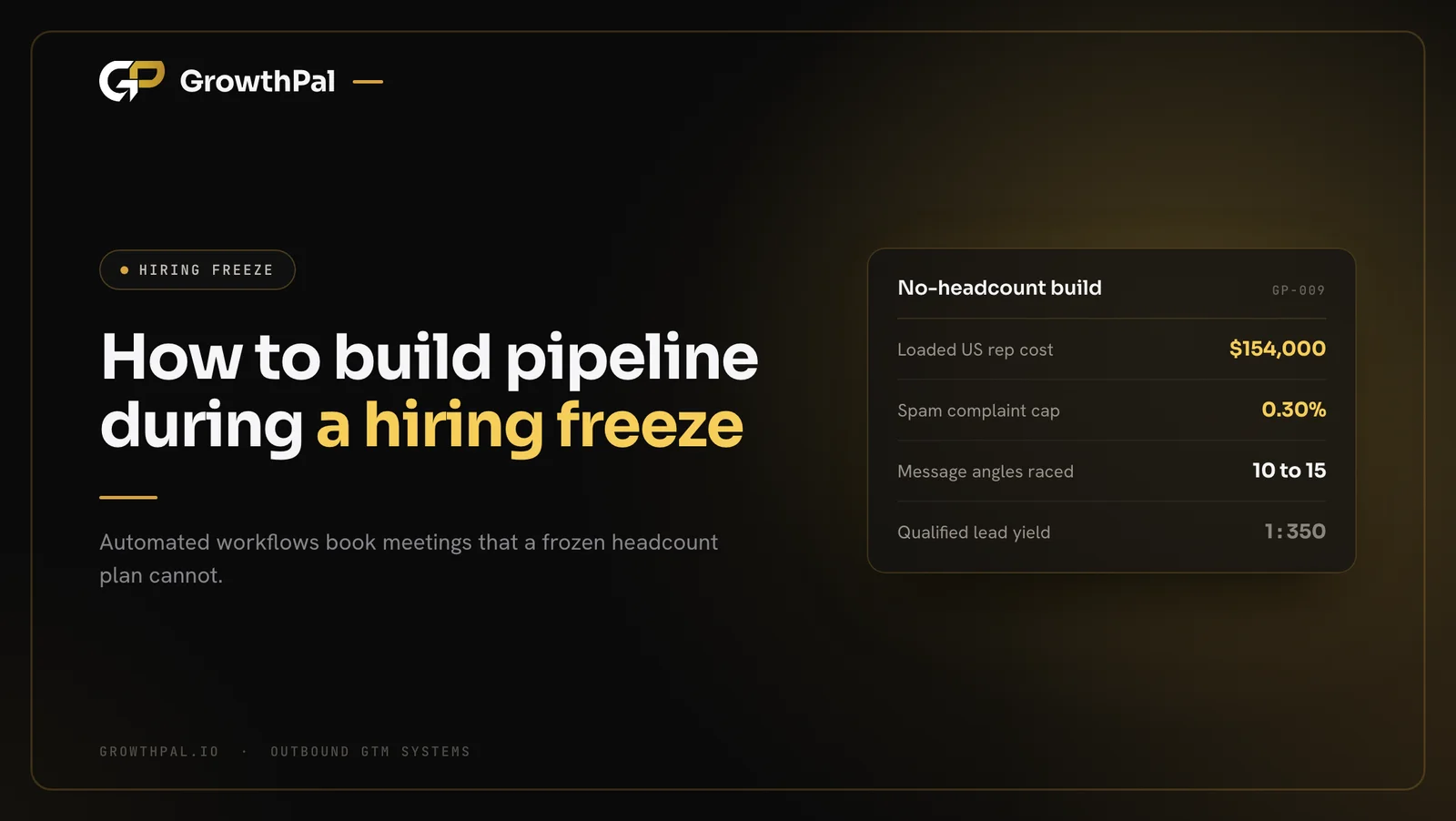
- Fully loaded US rep costs exceed $154,000, making manual volume outreach inefficient for lean teams.
- Google and Yahoo bulk rules strictly cap spam complaints at 0.30 percent, requiring extra infrastructure.
- Waterfall data enrichment is needed to keep hard bounces below the two percent inbox ceiling.
- Building an automated pipeline means racing 10 to 15 message angles to find market fit.
- AI agents can monitor job postings and tech changes to trigger highly relevant emails quickly.
- You can aim for one qualified lead per 350 contacts when pairing clean data with buying signals.
Why do traditional SDR models fail to hit outbound pipeline during hiring freeze?
Traditional models fail because rising sales salaries clash with plummeting reply rates and strict inbox rules. This forces lean companies to shift to automated systems during head count freeze periods.
Why do manual sales costs keep rising?
The median US sales rep has a fully loaded annual cost of $154,500, factoring in tools and taxes (Alleyoop, 2026). They take three full months to ramp up and leave in under two years (The Bridge Group, 2025). This constant hiring cycle ruins capital efficiency when budgets shrink.
Why is top of funnel conversion dropping?
Average cold email reply rates across the tech sector fell below two percent recently as inboxes grew crowded (Boomerang AI, 2026). As a result, 45 percent of sales leaders missed their pipeline goals due to poor prospecting returns (Gartner, 2025).
Can AI agents replace SDR workloads?
Using ai outbound workflows replacing sdrs solves this problem by taking over manual research. Software agents map a target market, clean messy lists and draft angle variants. A person writes or approves every message before it sends.
How does this change your pipeline math?
Knowing your exact pipeline math is vital when you cannot add staff. A single automated system processes thousands of contacts daily while searching for precise buying signals. By racing 10 to 15 different message variants across the market, you can find one qualified lead per 350 contacts reached.
How do you build a safe outbound pipeline during hiring freeze?
You must build an over-provisioned network of secondary domains that meets strict modern authentication standards. This prevents random mailbox blocks from pausing your automated campaigns and missing crucial targets.
How do you over-provision infrastructure?
A single set of inboxes will always face fatigue. We over-provision infrastructure by 50 to 100 percent to act as a permanent redundancy layer for clients. If one domain burns out, your campaigns keep running smoothly without any pipeline drop or rushed manual fixes.
What DNS records do you need?
Google and Yahoo force strict rules for bulk senders trying to reach primary inboxes today. You must set up SPF, DKIM, and DMARC records perfectly for every sending domain. Use a free dmarc generator to ensure your domain policies meet the exact technical rules required by major email providers.
How many emails can an inbox send?
New email inboxes need 14 to 21 days of warm up to build a good sender reputation safely. We then raise volume slowly, setting strict rules of 15 emails per inbox daily once fully ramped. Limiting each domain to two inboxes protects your sender reputation from strict spam filters.
How do you fix data quality and keep bounce rates low?
You must connect multiple data tools in a sequence to check contact details accurately. Relying on a single vendor leads to failure under current rules when outdated data bounces.
How does the waterfall sequence work?
Waterfall data enrichment links several data providers in order to find real email addresses. If the first tool fails to find a verified contact, the system checks a second and third tool automatically. This method keeps hard bounce rates below the two percent limit set by email providers.
What is the hard bounce ceiling?
Major platforms track cold bounce rates closely, setting a strict two percent limit before they pause your domain (Allegrow, 2025). High bounce rates tell Google that you are a spammer guessing email addresses blindly. We check lists with Reoon and BounceBan to keep bounces low and protect client email systems.
How do you design data architecture?
Every automated outbound campaign relies on clean data pipelines working perfectly. Starting every operations engagement by auditing where data comes from, where it goes, who owns it, and whether it is right before building anything is vital. This early check ensures your AI agents pull correct facts.
Are cold emails compliant with UK rules?
Under UK PECR, B2B emails to corporate bodies do not need prior consent, but staff keep their opt out rights (ICO). You must honour these opt out requests fast to stay legally compliant. Always add a clear unsubscribe link to satisfy modern Google bulk sender rules and protect your domain health.
How do you find trigger events for automated outreach?
You must direct AI agents to watch target accounts for real buying signals like job changes or tech updates. These clear triggers decide which highly relevant message a prospect gets.
What high intent signals matter?
Basic outbound sequences fail because they ignore buyer timing and current context completely. By watching triggers like fresh funding or old hardware drops, your emails become very useful to the reader. An AI agent can scan job postings to see when a company hires a new revenue operations leader.
How do you draft the message variants?
Once a signal fires, the system must write a custom response right away. Reading about how we write a cold email angle helps teams plan these different message variants well. Month one focuses on testing while warming inboxes, followed by aggressive testing in month two to improve the final text.
How long does finding message market fit take?
We race 10 to 15 very different message angles across the whole addressable market to find a clear winner. We use signals to decide who gets reached first. A winning message market fit is usually found by week eight of the testing programme, giving you a reliable asset that generates meetings.
Should you build internal systems or hire an agency?
Checking gtm engineering hiring alternatives shows building an automated system costs far less than hiring a manual rep. You must weigh tool costs against full salaries to make the right choice.
Comparing resource allocation
| Criteria | Manual SDR Hire | AI-assisted outbound system |
|---|---|---|
| Annual Cost | ~$154,500 fully loaded | Infrastructure, data and the team that runs it, scoped to your market |
| Ramp Time | About 3 months | 2 to 4 weeks to first sends |
| Data Method | One vendor, searched by hand | Waterfall enrichment across providers |
| Capacity | One person's working hours | Set by inboxes and domains, at 15 emails per inbox per day |
Choose a manual SDR if you have highly complex discovery needs. Choose an AI system to scale a lean pipeline creation strategy fast.
What does a manual hire cost?
Alleyoop puts the fully loaded annual cost of a US SDR at about $154,500 once base pay, benefits and software are counted (2026). Reps typically book about 10 qualified meetings a month (The Bridge Group, 2025). That is roughly $1,300 per meeting before anyone closes a deal, which is a lot for a lean team.
How fast can you launch?
A new manual rep takes three months to reach full speed and book steady meetings (The Bridge Group, 2025). In contrast, setting up technical outbound systems takes just two to four weeks from start to sending. This speed helps you fix lost pipeline capacity fast during a hiring pause.
Who keeps the technical asset?
When checking a cold email agency vs in house sdr, you must ask who owns the technical build at the end. GrowthPal either builds the system, documents it and trains your team to run it, or runs it month to month. Either way you own the domains, sequences, routing rules and enrichment logic for good.
Outbound Services
Need to maintain outbound pipeline during a hiring freeze without the heavy SDR overhead? GrowthPal builds and runs full-TAM outbound systems to find your message-market fit. We handle the technical infrastructure so you can focus on closing.
How can AI agents handle cold email replies safely?
AI systems can route positive responses, update CRM sales records, and flag interested buyers for fast follow up. This ensures human help is only needed when a prospect actually wants to speak.
How do you route replies?
When a prospect writes back, the system must sort the reply intent fast. Modern tools let you review automated AI tools to read the text and see if the reply is positive, a referral, or a clear no. The workflow then sends good replies straight to a closer.
Why does fast follow up matter?
Speed is vital when dealing with interested replies from your automated outbound campaigns. With fast follow up, 25 to 40 percent of interested replies become booked meetings on your main calendar. The automated system makes sure no positive response sits unread in an unmonitored inbox for days at a time.
Where do humans step in?
While software agents handle the heavy lifting, human thought remains needed for true quality control. A human writes or approves every single message that reaches a prospect to ensure facts are right. This mixed approach stops silly bot errors and keeps the professional tone of your brand intact during outreach.
How do Google and Yahoo bulk rules affect small teams?
Stricter inbox rules mean any domain passing spam limits will face hard blocks rather than short delays. This forces outbound systems to focus on clean deliverability facts over sheer sending scale.
How do you stay below spam limits?
Google permanently flags domains sending big volumes to personal emails as bulk senders today. Spam complaint rates must stay below 0.10 percent and never hit the 0.30 percent hard limit (Google Workspace Help, 2025). Hitting these limits causes fast temporary delays or total domain blocks, halting all pipeline generation.
What are Microsoft spam restrictions?
Microsoft forces strict rules for senders reaching consumer and hosted inboxes. They assign a Bulk Complaint Level from zero to nine for incoming mail (Microsoft Learn). Messages passing a level of six or seven are quickly junked by internal defender tools before buyers see them, making it impossible to book meetings.
Should you disable open tracking?
We never claim open rates or click rates because we leave tracking pixels off entirely. Tracked opens and clicks embed resources that spam filters look for on cold mail, and image prefetching makes the numbers unreliable anyway. Focus completely on positive reply rates and booked meetings as your main performance tracking metrics instead of opens.
What testing tools should you use?
Before you launch, you must check your technical setup is perfect and ready for work. Use a free cold email grader to check your copy for common spam trigger words. Check your sending domains often to spot setup errors before they hurt your main deliverability health and cause bounces.
How do you launch a new automated pipeline system?
You must define your target market, fix your data base, and test multiple angles in a set order. Following a strict order prevents early mistakes and builds real momentum.
How do you define your market?
Your ideal market size should be at least 30,000 reachable contacts for good test results. Markets with 50,000 to 300,000 contacts give the volume needed for real math when testing angles. We map these contacts during the start phase to ensure enough runway for your new automated email campaigns.
How do you run testing phases?
Month one is spent testing while warming the inboxes up safely and slowly. Month two moves into hard testing across market groups to find the strongest buying signals. By month three, you scale the winning angle that brings steady positive replies and reliable building pipeline without sdr hiring efforts.
What outcomes can you expect?
Clean tracking is vital for any firm launching lead generation during head count freeze efforts. For one real estate client, a GrowthPal reactivation campaign across ad leads and past contacts reached 1,116 people and produced 137 replies and 104 opportunities in 27 days, with no new hires. On another campaign, the winning angle earned 202 positive replies from 4,303 contacts, and 83.47 percent of its replies were positive.
Pipeline generation checklist
- Define your total addressable market size accurately.
- Buy 50 to 100 percent more domains than needed.
- Configure SPF, DKIM, and DMARC records correctly.
- Build a waterfall data enrichment sequence.
- Write 10 to 15 different message angles carefully.
- Identify three distinct buying signals to track daily.
- Warm up your inboxes for 14 to 21 days.
- Limit sending to 15 emails per inbox daily.
- Turn off all open and click tracking pixels.
- Route positive replies to account executives immediately.
Free GTM Plan
Ready to start lead generation during a head count freeze? Get a mapped market, buyer breakdown, 5 message angles, and 5 signal plays delivered within an hour. This actionable plan provides the exact strategy needed for your specific market.