How Should a SaaS Founder Plan Outbound Between $1M and $3M ARR in 2027?
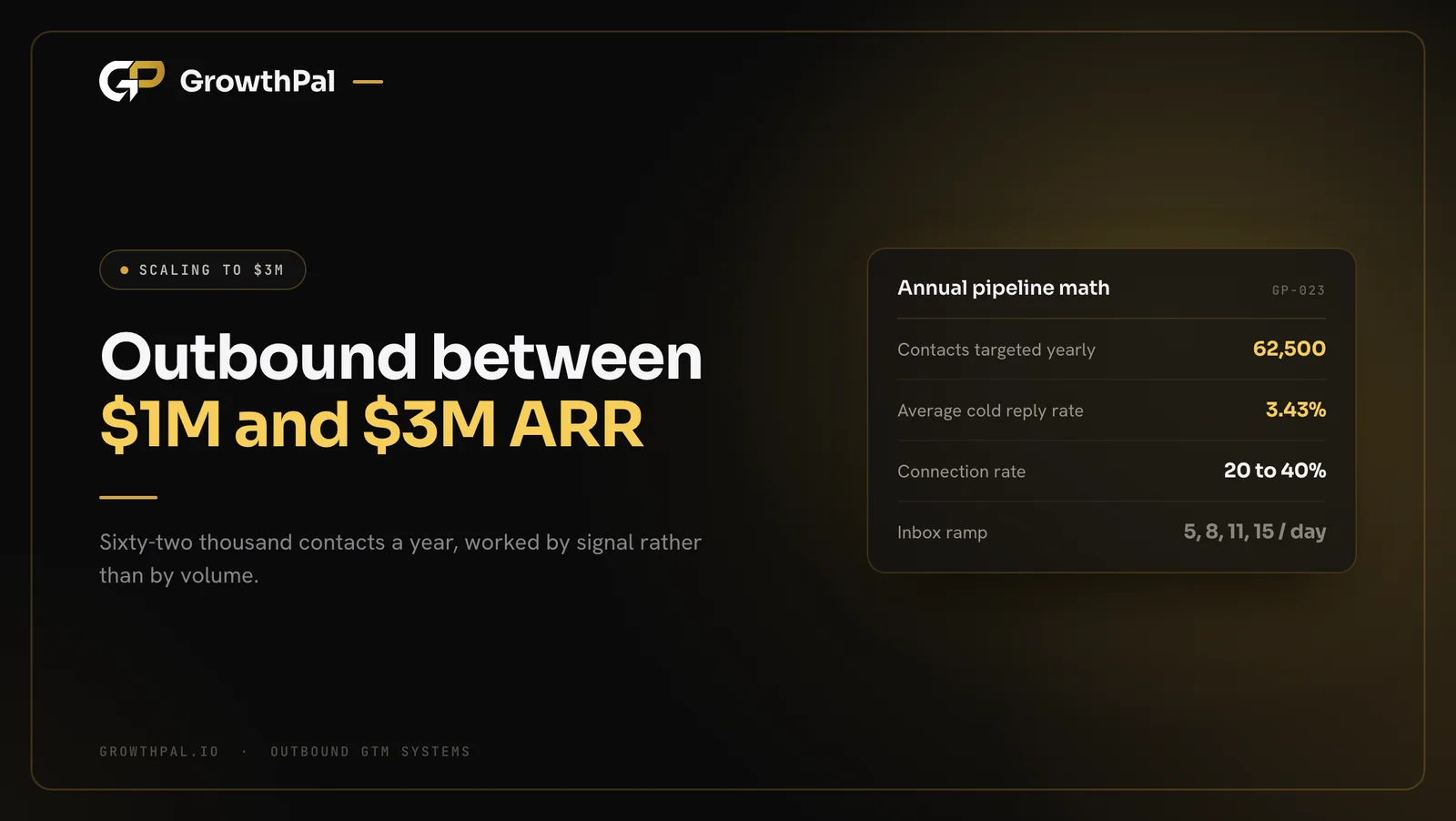
TL;DR Between $1M and $3M ARR, run the maths before you build: at a $20,000 contract value, adding $2M from outbound alone would take 625,000 to 1,000,000 contacts a year at a realistic 1 in 350 rate. Most markets cannot carry that, so plan outbound as one measured channel, prove the offer with strangers, and scale what tests well.
Moving from founder led sales to outbound is the hardest test for a growing software firm. This guide outlines a technical saas outbound strategy 1m to 3m arr to help you scale safely. You will learn the exact maths, tech setups, and testing steps needed to hit revenue goals.
Key takeaways
- Volume-based cold emails are strictly blocked by modern provider rules.
- A clear hand-off needs much more top-of-funnel reach to offset lower closing rates.
- Multi-domain setups are vital to keep your main brand safe from spam traps.
- Finding the best message means racing many unique angles across your market.
- Smart outbound uses clear signals like executive job changes to time outreach.
- Clean CRM data and list checks are key to keeping bounce rates low.
What Is the Reality of a saas outbound strategy 1m to 3m arr?
Growing past the early stages means you must leave founder networks behind. You need a safe system that brings in leads on a set schedule without burning your main domain.
Why Is Volume-Based Outbound Dead?
Volume-based cold email is strictly dead today. Mail providers now block domains that send too much untargeted mail. Google rules state that senders with a spam rate above 0.3 percent face harsh penalties.
You must build smart, signal-led systems to reach the inbox safely. Blasting static lists will easily ruin your main corporate domain and destroy all your future sales efforts.
The Maths Behind the Hand-off
Moving away from founder sales drops your daily conversion rates fast. Bridge Group data from 2025 shows first-touch meeting conversions fall 50 to 80 percent with new reps.
You must grow your top-of-funnel reach to make up for this steep drop. Doing this keeps your closed-won revenue steady across the year, even when your win rates decline slightly.
When Should You Invest in Outbound Sales SaaS?
Founders often ask when to invest in outbound sales saas. Build your outbound systems when you have an offer that already sells and a market of at least 30,000 reachable contacts. GrowthPal's ideal client is past $3M ARR with one channel working; below that, the first job is proving the offer sells to strangers.
Founders must then step back and let data pick the message. For a D2C and retail client, GrowthPal's tested campaigns produced 183 positive replies from 43,043 emails over three months.
GTM Engineering for Scaling SaaS
GrowthPal builds smart revenue systems for growing B2B firms. We call this exact discipline gtm engineering for scaling saas.
We build large setups that test many angles without risking your main domain. This creates a machine that runs well on its own rather than relying on individual sales heroics, ensuring predictable pipeline growth.
How Do You Map a saas outbound strategy 1m to 3m arr?
You must calculate the exact number of emails needed to hit your targets. This ensures your outbound lead generation for 2m arr saas has enough budget to work.
What Is the Exact Pipeline Math?
Adding new revenue starts with clear maths. If your deal size is $20,000, you need 100 deals to add $2M. With a 20 percent win rate, you need 500 qualified opportunities a year.
Working Backwards to Meetings
If about 70 percent of held meetings become qualified opportunities, 500 opportunities need roughly 714 meetings. With fast follow-up, 25 to 40 percent of interested replies become meetings, so you need about 1,785 to 2,856 interested replies a year.
Calculating Required Contact Volume
At GrowthPal's aim of one interested reply per 350 contacts reached, that is 625,000 to 1,000,000 contacts a year from outbound alone. Few SaaS markets hold that many reachable buyers, which is the honest point: outbound is one channel of several, and contract value changes everything. At a $50,000 contract value, the same $2M needs 40 deals and roughly 250,000 to 400,000 contacts.
Use an inbox calculator to see how many mailboxes your share of that volume needs at 15 emails per inbox per day. Track outbound booking rates against these numbers from the first month.
How Do You Build Deliverability Infrastructure?
A safe sending setup is key for any saas outbound infrastructure roadmap. You must spread your daily sends across extra domains to protect your main brand reputation.
What is the Exact Outbound Tech Stack Needed?
A safe outbound tech stack needs extra sending domains, two mailboxes per domain, and strict DMARC rules. Each mailbox should send just 15 emails a day once fully ramped. Multi-domain setups keep you safely below strict volume limits set by modern mail providers.
How Do You Structure Secondary Domains?
A SaaS firm needs extra domains like trybrand.com or getbrand.com. Set up two mailboxes per domain to keep your main corporate email perfectly safe from any spam reports.
We over-provision inboxes by 50 to 100 percent to act as a backup. This stops campaigns from stalling if one inbox fails or gets flagged by strict provider filters.
Implementing Email Authentication
Microsoft blocks emails that fail basic checks if you send in bulk. Rules from 2025 show failed emails face hard blocks at the server level, preventing any delivery.
Use a dmarc checker to view your current setup. Proper records are the only genuine way to reach modern inboxes safely and consistently.
Warming Up and Ramping Inboxes
You must warm inboxes for 14 to 21 days before sending cold mail. After that, ramp them up slowly at 5, 8, 11, and 15 emails per day.
Strict daily limits keep each inbox inside safe volumes and make problems visible while they are cheap to fix.
How Do You Manage Transitioning from Founder Led Sales to Outbound?
Founders must turn their deep market knowledge into steps that anyone can follow. This means moving from private network chats to clear, data-driven outreach campaigns.
How Do You Extract Founder Knowledge?
The big hurdle in transitioning from founder led sales to outbound is sharing what actually works. Founders use their own trust and gut feeling, which new reps totally lack.
You must record sales calls to find the exact words that make buyers lean in and listen closely. This creates a script based strictly on reality.
Structuring the Handover
Do not hire a new rep and expect them to guess the right words. Founders should test the first angles themselves to validate the core messaging before delegating.
Use a reply rate calculator to check early results. The new rep can take over execution once the maths make perfect sense and the leads flow freely.
Managing Expectations and Quotas
New reps will not match a founder's closing rate right away. Set fair quotas based on a wider top-of-funnel reach to compensate for their initial learning curve.
Month one is for testing while ramping inboxes safely. Month two brings aggressive testing, and month three scales the clear winner across your entire addressable market.
Should You Hire an Internal SDR or an Agency?
Many founders wonder whether to hire their first rep or use a specialist agency. The right choice depends on your time and how fast you need leads. An in-house team gives control but takes months to train and run.
Internal SDR vs Revenue Engineering Agency
| Feature | Internal SDR Hire | Revenue Engineering Agency |
|---|---|---|
| Speed to Launch | 2 to 3 months | 2 to 4 weeks |
| Infrastructure | Needs founder time | Fully built and managed |
| Messaging | Uses basic templates | Tests 10 to 15 angles |
| Cost Type | Salary plus software | Fixed monthly fee |
| Choose an internal SDR if you have a sales manager ready to help them every single day. Choose an agency if you want a fast, safe system built for you. |
What Are the Hidden Costs of In-House Teams?
An internal team needs costly software and inbox fees on top of their base pay. You also have to deal with staff leaving and taking their skills with them.
If you weigh a cold email agency vs in house sdr, do not forget the sheer management time it costs the founder to monitor daily metrics.
Evaluating Cold Email Agencies
Not all agencies build technical assets that you actually own. A true revenue engineering partner builds the entire outbound system in your brand's name, giving you total control.
GrowthPal offers two engagement models, build and hand over or run month to month, and in both you keep the domains and logic. You own the asset no matter which path you decide to take for your business.
Leveraging B2B Expertise
A good cold email agency brings tested plans across many distinct B2B sectors. Campaigns run by GrowthPal's team have earned replies from people at Apple, Google and Stripe using this direct approach.
We test genuinely different message angles across the whole market to find message-market fit quickly and effectively.
Scale Without Management Overhead
Building an internal team takes months. Our Outbound Services offer full-TAM systems built and run to find message-market fit. We handle the technical setup, signal checks, and strict testing, giving you a steady pipeline fast.
How Do You Find Message-Market Fit?
You cannot guess what will make your buyers reply at scale. Strict testing of many distinct angles is the only way to find a winning message.
Racing Different Message Angles
We find message-market fit by racing 10 to 15 very different angles at the same time. These are not small tweaks, but entirely new ways to pitch your core value.
We usually find a winning message by week eight. You must track what works best carefully to scale positive reply rates and book more meetings.
How Do You Understand Positive Reply Rates?
An Instantly report from 2026 notes a 3.43 percent average cold reply rate. However, total replies include angry rejections which waste time and drain team morale.
We focus solely on positive replies for our clients. The benchmark aim is one qualified lead per 350 contacts reached, ensuring your reps only speak to interested buyers.
Writing Problem-Centric Hooks
A cold email hook must focus on a clear problem and offer a specific fix. Seeing how we write a cold email angle shows that pointing out slow operations works well for busy leaders.
End with a soft push like, "Worth a seven-minute look, or are you sorted here?" This removes all friction from the reply.
How Can You Scale Signal-Based Outbound Plays?
Blasting cold lists does not work for scaling software firms anymore. Modern outbound looks for clear data signals to choose who gets an email first.
Using Tech-Stack Migrations
Tech data gives a very strong signal for outbound sales. If a firm just bought a new tool, they are ready to spend cash and fix their broken processes.
Naming the migration in the first line easily beats a feature pitch.
Monitoring Executive Job Changes
A new boss is one of the best triggers in B2B sales. New leaders want to make fast changes and hold active budgets to solve legacy business problems.
Reaching out in their first 90 days boosts your chance of booking a call. Personal notes about executive job changes work very well to grab their attention.
Navigating LinkedIn Restrictions
LinkedIn strictly caps invites to roughly 100 to 200 per week. They block bad browser tools, so you must use safe social touches to protect your active accounts.
Belkins data from 2025 shows a 20 to 40 percent connection acceptance rate for B2B outreach, so LinkedIn works best as a supporting touch alongside email.
Can AI Agents Handle Email Workflows?
AI agents map markets, scrub lists, and watch for signals with ease. You can also run text through a spam word checker to stay safe from strict inbox filters.
Yet, a human must write or approve every message that reaches a buyer. Full AI sending feels very fake and ruins your brand trust fast.
Why Is Clean Data Crucial Before Launching?
Outbound fails when bad data clogs the system and causes high bounce rates. Keeping your lists clean is vital before any outreach starts. Clean data keeps your domains safe and helps reps focus on real buyers.
The Importance of RevOps Auditing
We start every operations deal by auditing where data comes from and who actually owns it. This deep audit checks if the base is right before we build anything new.
Keeping your crm data hygiene perfect stops your outbound engine from breaking down under heavy daily load, ensuring steady leads.
How Do You Validate Contact Lists?
Hard bounce rates above 2 percent damage your mailbox reputation fast. We verify lists with tools like Reoon and BounceBan to keep bounces strictly under this line.
You can also run domains through a blacklist checker. Clean data is an absolute must to hit target hard bounce rates and protect your domains.
Ensuring Global Compliance
PECR's consent rule for marketing email (regulation 22) covers individual subscribers, so cold B2B email to UK corporate subscribers does not need prior consent. You must show a clear reason to email, state who you are, and add a functional opt-out link.
Always check local rules: Germany requires prior express consent. This is general guidance, not legal advice.
Pre-Launch Outbound Checklist
- Buy and set up extra sending domains.
- Add proper SPF, DKIM, and DMARC records.
- Over-provision your mailboxes by 50 to 100 percent.
- Warm up all new inboxes for 14 to 21 days.
- Map out your pipeline maths and revenue goals.
- Verify all contact lists to keep bounce rates low.
- Draft 10 to 15 genuinely different message angles.
- Set up fast reply routing and workflow rules.
- Audit your CRM to ensure clear data ownership.
- Launch campaigns with strict daily volume limits.
Start with Solid Mathematical Ground
Want to see the data before you launch? Request our Free GTM Plan to get a mapped market, buyer breakdown, 5 message angles, and 5 signal plays delivered within an hour. This ensures your scaling efforts start perfectly.