How Many Hours a Week Should a Founder Spend on Outbound Review in 2027?
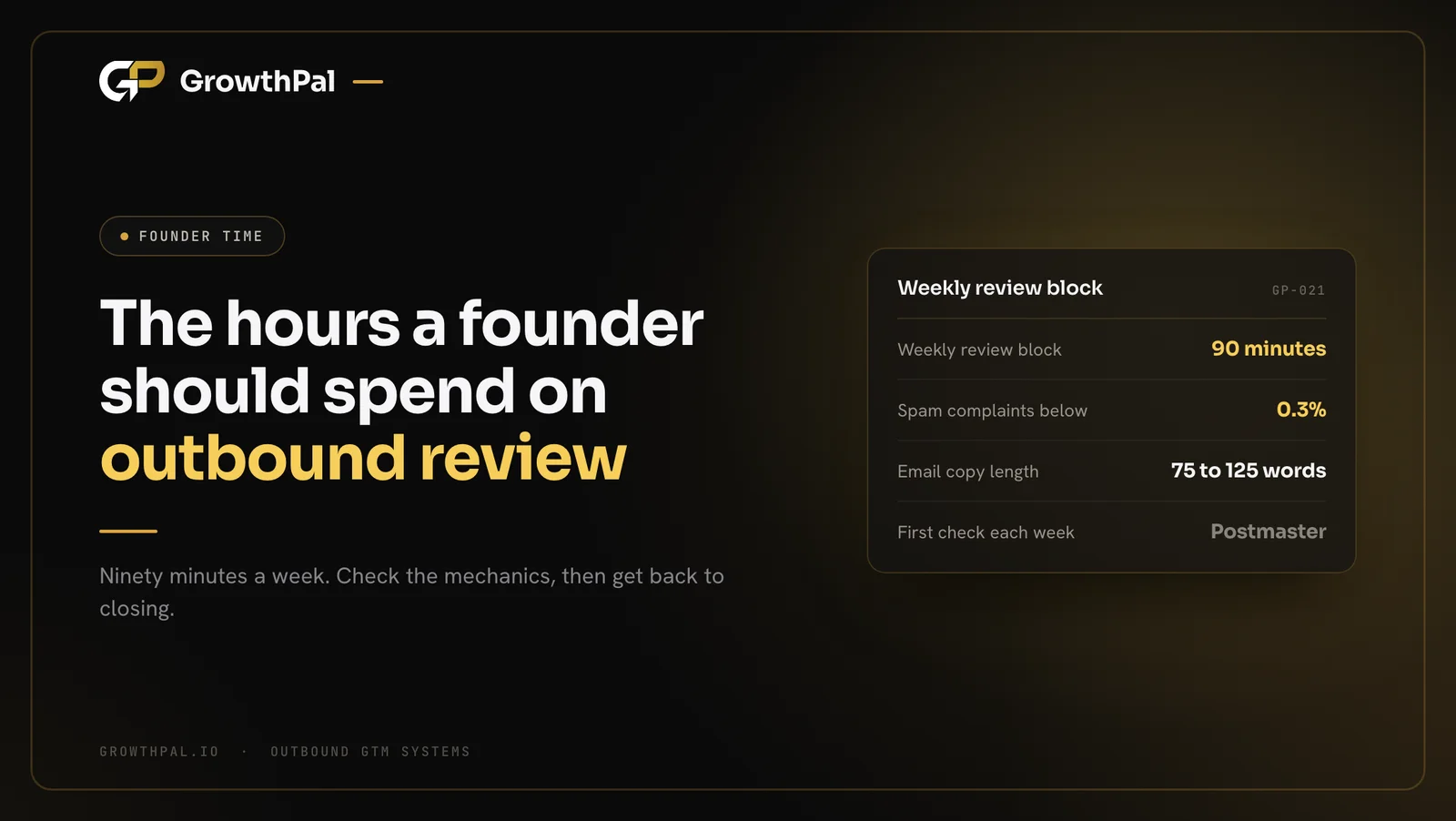
TL;DR Once an outbound system is running, about 90 minutes a week is enough founder review time: 15 minutes on deliverability, 25 on targeting, 25 on messaging and 25 on replies and compliance. Review the system, not individual emails, and leave the rest to the team running it.
A B2B founder can keep outbound on track with about 90 minutes of review a week. This guide breaks down the precise system to check delivery and messages without managing your sales team too closely. You will learn how to protect your sending domains while keeping lead quality high.
Key takeaways
- Restrict your weekly audit to a strict 90 minute block to stop yourself from managing too closely.
- Always check Google Postmaster Tools first to keep spam complaints safely below 0.3 percent.
- Check twenty contact records manually before any new campaign launches to verify market fit.
- Read your active email copy to confirm hooks fall within the ideal 75 to 125 words.
- Read rejection emails carefully to fix your targeting filters and drop wrong buyer types.
- Check sequence rules regularly to confirm you meet UK PECR and GDPR legal needs.
What Is The Main Problem With Founder Outbound Review Time?
Many leaders waste hours rewriting sales emails. Others ignore the process completely until campaigns fail. A strict founder outbound review time limits your work to quality checks and simple oversight. This clear routine stops campaign failure.
Why separate sales calls from pipeline mechanics?
Early stage leaders often sell too much instead of building systems. Deciding how much time should founders spend on sales means balancing quick cash with long term health.
Separating sales calls from pipeline mechanics keeps your focus sharp. Proper founder time allocation b2b sales needs checking inputs over final meetings.
Why does delivery need your oversight?
Technical system failures freeze your revenue engine if ignored. Major inbox providers block bulk sending that lacks proper checks. You cannot outsource this risk without weekly oversight.
Watching Google's 0.3 percent spam complaint ceiling, and keeping well below 0.1 percent, stops a domain problem before it spreads. This basic check takes minutes but saves your sales channel.
How do you start delegating outbound review workflows safely?
Giving prospect replies to a junior worker needs a clear plan. You need defined metrics that signal when a campaign needs executive help.
Successful delegating outbound review workflows relies on checking system trends rather than single email replies. This stops you from stepping into threads and keeps your team fast.
The danger of checking cold outreach too closely
Changing email drafts stops the testing cycle needed to find winning angles. A 2025 Sandler Research study shows only 32 percent of companies give enough operational help to their teams.
You must give representatives space to run planned tests. The time founders spend on outbound must focus purely on strategy.
How Do You Check Infrastructure Health First?
The first fifteen minutes of your routine must focus entirely on domain health metrics. Sudden campaign blocks frequently start from ignored technical warnings. Catching these early keeps your outreach active and safe.
What metrics matter in Google Postmaster Tools?
Domain health dictates whether your messages reach the primary inbox. You must check your status across all sending domains every week. If spam complaints pass the critical limit, automated filters block your traffic.
Regular checks catch negative trends before they cause system failure. This stops major providers from shutting down your outreach.
How do you keep bounce rates below risk lines?
Sending messages to bad addresses hurts your sender score fast. You must use an accurate bounce rate calculator to track weekly delivery failures.
Keep bounce rates under 2 percent; above that line, mailbox providers start treating you as a sender who guesses addresses. Checking your contact lists consistently keeps your delivery metrics safe.
Managing secondary domain rotation
Relying on a single primary domain for corporate outreach invites huge risk. GrowthPal over provisions inboxes by 50 to 100 percent to act as N+1 redundancy.
You must use an inbox calculator to plan required sending capacity accurately. Rotating multiple secondary domains ensures your volume limits remain safe when inboxes burn out.
How Do You Inspect Targeting and Market Relevance?
Spend twenty five minutes checking contact lists to verify facts before launch. Reaching the wrong buyer wastes your technical resources and harms your reputation quickly. Clean lists keep your domains completely safe.
How do you spot bad prospect data early?
Founders must manually check at least twenty prospect records in each new batch before launch. Check each record's industry and employee count against your ideal customer profile, and run the addresses through an email checker.
Spotting bad prospect data early catches targeting errors before you burn good lists.
Auditing LinkedIn outbound workflows
Social platforms watch connection habits to stop spam. You must verify that your team respects the safe limit of 100 to 200 weekly invitations based on the 2025 Linked Helper Consensus.
Exceeding limits, including the small monthly allowance of personalised notes on free accounts, brings account restrictions. Keeping volume low keeps the profile usable.
Evaluating total addressable market mapping
Your targeting rules must yield enough volume to support constant testing cycles. Check every list's domains against your CRM before launch so current customers are excluded.
Review geographic and industry filters to confirm your audience is large enough. Narrowing focus too early limits your chance to find high performing segments.
Defining precise buyer personas
Different leader roles need very different plans. A chief financial officer wants to lower risk. An engineering leader wants technical speed.
You must verify that your prospect lists accurately reflect the specific titles your campaigns target. Misaligned personas create irrelevant emails, and irrelevant emails create spam complaints.
How Do You Review Copy Brevity and Angle Variance?
Dedicate twenty five minutes to reading the hooks and calls to action across active sequences. Removing generic messaging stops your accounts from getting high rejection rates. Short emails perform best.
Testing multiple message angles simultaneously
Finding true market fit requires running varied tests against your target audience. GrowthPal races 10 to 15 completely different message angles across the entire addressable market.
This finds the one that yields 1 interested reply per 350 contacts. Read how we write a cold email angle to see how this aggressive testing reveals real commercial interest.
How do you audit cold email copy for ai clichés?
Automated writing tools often produce bloated text filled with strange corporate jargon. You must use a spam word checker to find and cut these harmful phrases.
Auditing cold email copy for ai clichés keeps your tone human. Replacing a long automated introduction with a short observation about a recent funding round improves trust.
Optimising email length and soft ctas
Long paragraphs visually overwhelm readers and drop positive reply chances. A 2025 Lemlist Study shows the ideal email length sits between 75 and 125 words.
Optimising email length and soft ctas keeps replies high. 2025 Gong Labs data shows interest-based calls to action drive 68 percent positive responses, against 41 percent for direct meeting requests.
Agency Managed Sending Versus In House SDRs
Founders must decide whether to build systems internally or hand them to specialists. Managing outbound pipeline as a founder requires understanding the technical weight of each route. Both paths demand strict domain oversight to succeed.
Choosing your outbound operational model
| Feature | Managed Outbound Agency | In House SDR Team |
|---|---|---|
| Setup Time | Two to four weeks | Three to six months |
| Delivery Management | Handled by specialists | Requires internal team |
| Technical Load | Very low | Very high |
| Cost Structure | Agreed fee for agreed scope | Salaries and software |
Choose a managed agency if you need rapid market testing without technical distractions. Reading a comparison of a cold email agency vs in house sdr helps clarify these options.
How do you assess cold email agency alternatives?
Many leaders struggle to justify the time needed to build internal systems. Assessing cold email agency alternatives helps you understand the operational costs of scaling revenue.
You must check whether your internal team has the technical skill to keep deliverability high. Outsourcing the infrastructure build often speeds up finding a winning message.
Calculating outbound customer acquisition cost
Knowing your conversion metrics is vital for long term growth plans. You must routinely review your pipeline math to make sure outreach efforts create profitable returns consistently.
Calculating outbound customer acquisition cost highlights operational waste clearly. This calculation dictates whether you should increase sending volume or refine targeting rules.
Spotting red flags in volume first agencies
Some service providers rely on massive sending volumes without respecting domain health. Spotting red flags in volume first agencies protects your brand from severe damage.
Ask any agency what it sends per inbox per day, how many inboxes it puts on a domain, and whether it tracks opens. Answers like 50 a day, five per domain and open tracking on are the warning signs. If the approach is volume first, your reputation pays for it.
Let GrowthPal Build Your Outbound Infrastructure
Stop wasting hours fixing domain health. GrowthPal builds and operates full TAM outbound systems designed to find message market fit predictably. We handle the technical operations so you can focus entirely on closing qualified deals.
How Do You Diagnose Negative Feedback and Objections?
Use the final twenty five minutes of your review to read unsubscribes and rejection replies. This negative feedback provides vital data to fix your future targeting filters. Fixing these errors keeps spam rates low.
Why read the last twenty objection emails?
Negative responses highlight precise errors in your audience assumptions. Reading the last twenty objection emails that state the recipient is the wrong person reveals deep errors in your contact enrichment process.
You must adjust exclusion filters based directly on this recurring feedback. Constant refinement stops your team from annoying the wrong executives.
Classifying positive replies accurately
Not every reply claiming interest becomes a real sales chance. You must audit how representatives group replies to confirm accurate pipeline reporting.
GrowthPal observes that 25 to 40 percent of interested replies typically become actual meetings with fast follow up. Grouping simple information requests as qualified leads creates dangerous revenue errors.
Tracking the single qualified lead benchmark
Establishing clear performance baselines helps evaluate audience segments. A 2026 Belkins Study indicates an average unique reply rate of 0.45 percent across cold channels.
Track interested replies per contact reached against GrowthPal's aim of 1 in 350; the industry norm for an untested message is 1 per 800 to 1,000. For a D2C and retail client, GrowthPal's campaigns produced 183 positive replies from 43,043 emails over three months.
How Do You Maintain Strict Legal Compliance Routines?
You must regularly audit your sequences for proper opt out mechanisms and data processing alignment. Failing to respect regional marketing laws invites financial penalties and damaged domains. Routine checks keep you safe.
How do you navigate uk pecr rules on cold outreach?
Different regions apply different rules to corporate marketing. The UK permits cold outreach to corporate bodies if you include clear identity transparency and immediate opt out options.
Navigating uk pecr rules on cold outreach keeps you safe. You must verify that campaigns strictly target corporate entities rather than sole traders. This is general guidance and not legal advice.
Aligning with EU GDPR legitimate interest
Using personal data for outreach needs a clear legal plan in the European Union. You must run a valid interest check before launching campaigns here.
Your weekly audit should confirm data storage policies align with these strict privacy frameworks. This ensures your revenue operations remain secure against regulatory checks.
Enforcing one click unsubscribe headers
Major inbox providers now mandate strict technical requirements for processing recipient opt outs. You must verify your sending tools support standard RFC 8058 one click unsubscribe headers globally.
Failing to configure this correctly means users mark messages as spam instead. Send a test to yourself and check the List-Unsubscribe headers, and check authentication with a DMARC checker.
Protecting personal data processing
Your revenue team must map exactly where prospect data comes from and where it goes. Storing extra personal contact details increases risk during legal audits.
You should implement automated deletion protocols for contacts who bounce or unsubscribe from your sequences. Maintaining a lean database protects your business from unnecessary compliance exposure.
What Is The Exact 90 Minute Founder Outbound Review Time Checklist?
A structured founder outbound review time removes emotion from your sales operations. Use this practical framework to check your campaigns efficiently every week. Consistent inspection keeps your growth engine reliable.
Minutes zero to fifteen on infrastructure
Begin your weekly routine by auditing technical delivery mechanisms. Check authentication records across all active secondary domains to verify they remain properly aligned.
You must verify that spam complaint rates sit comfortably below critical limits. Addressing technical warnings immediately prevents small errors from halting your entire revenue engine.
Minutes fifteen to forty on targeting
Dedicate the next block to inspecting the actual people your team targets. Spot check industry classifications and employee counts of the newest prospect batches manually.
You must also confirm that current clients are explicitly excluded from all active outreach. Catching bad data here saves your domain reputation from unnecessary damage later.
Minutes forty to sixty five on messaging
Spend this segment reviewing the exact words reaching your target market. Read the newest campaign copy to confirm hooks are concise, relevant, and free of generic industry jargon.
You should make sure calls to action focus on generating interest rather than demanding calendar time. Clear messaging consistently yields better conversion rates across all sectors.
Minutes sixty-five to ninety on replies and compliance
Close with the replies. Read the latest objections and unsubscribes, adjust exclusion filters, and confirm every sequence still carries a working one-click unsubscribe.
The founder weekly outbound review checklist
- Check Google Postmaster Tools for spam complaints under the required limit.
- Verify bounce rates remain below 2 percent across all sending domains.
- Spot check twenty new prospect records for accurate industry and employee count.
- Ensure current clients are dropped from all active prospect lists.
- Read active email copy to confirm messages sit under 125 words.
- Review hooks to ensure they address real operational pain points.
- Check LinkedIn automation tools to respect the safe weekly invitation limits.
- Read twenty recent unsubscribes to fix your targeting rules.
- Analyse negative replies to diagnose alignment issues with your buyer types.
- Confirm all sequences contain visible and compliant one click unsubscribe headers.
Get Your Complete Go To Market Plan Today
Audit your entire outbound strategy without the guesswork. Receive a mapped market analysis, a detailed buyer breakdown, five distinct message angles, and five signal plays delivered within an hour.